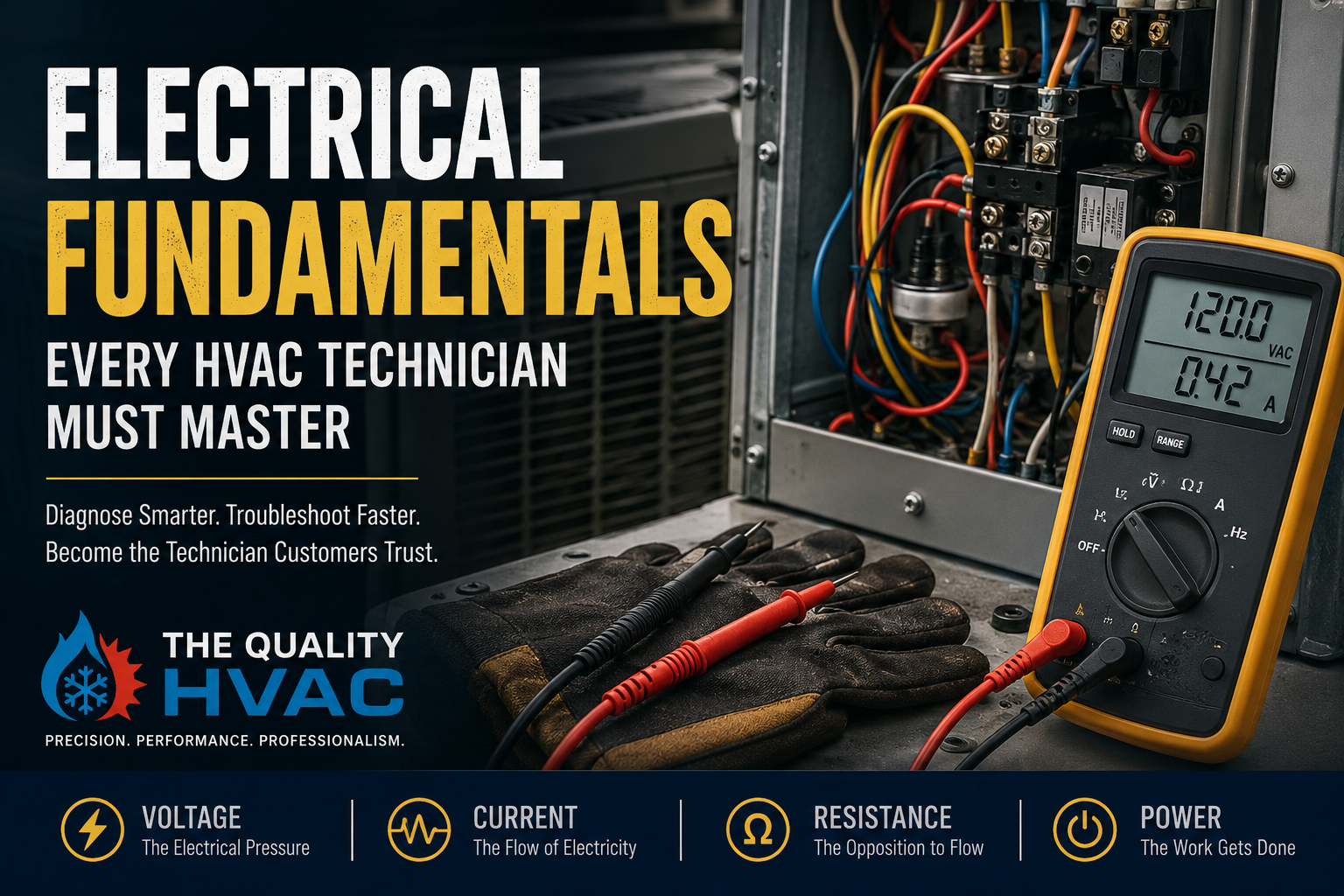
Electrical Fundamentals Every HVAC Technician Must Master Before Troubleshooting Modern Equipment
The HVAC industry has changed dramatically over the last two decades. Mechanical systems that once relied on simple controls now integrate electronic ignition modules, variable-speed motors, inverter-driven compressors, intelligent control boards, communicating thermostats, and sophisticated safety circuits.
Yet despite these technological advances, every HVAC system still obeys the same electrical principles.
- Voltage.
- Current.
- Resistance.
- Power.
Technicians who understand these fundamentals diagnose failures with confidence. Those who don’t often rely on trial-and-error troubleshooting, increasing repair costs, callbacks, and customer frustration.
Electrical theory is not simply academic knowledge. It is the language every HVAC system speaks.
Every Electrical Fault Leaves Evidence
Electrical failures rarely occur without warning.
A blown fuse, tripped breaker, failed contactor, overheated conductor, or open safety switch represents the final stage of an underlying problem rather than the problem itself.
Professional troubleshooting begins by asking a simple question:
What electrical condition caused this component to fail?
Replacing components without identifying the root cause often restores operation temporarily while allowing the original fault to remain hidden.
Successful technicians diagnose systems. They do not diagnose symptoms.
Voltage Does Not Mean the Circuit Is Healthy
One of the most common misconceptions among inexperienced technicians is assuming that the presence of voltage confirms proper circuit operation.
It does not.
Voltage represents electrical potential, not electrical work.
A technician may measure 24 VAC at a control board, yet the equipment remains completely inoperative because current cannot flow through an open limit switch, failed relay coil, broken conductor, or defective safety device.
Understanding this distinction separates measurement from diagnosis.
Voltage tells you what is available.
Current tells you what is actually happening.
Current Is the Story Every Technician Should Read
Electrical current is the most honest indicator of equipment operation.
Every energized load draws current according to its electrical characteristics.
A compressor with excessive current draw may indicate:
- High mechanical loading
- Locked rotor conditions
- Low supply voltage
- Internal winding damage
- Refrigeration system problems increasing compression ratio
Conversely, low or zero current often indicates:
- Open circuits
- Failed windings
- Defective contactors
- Open overloads
- Broken conductors
Experienced technicians rarely stop after measuring voltage.
They immediately ask:
“Is the expected current flowing?”
Resistance Testing Is More Than Finding an Open Circuit
Resistance measurements are frequently misunderstood.
Many technicians use an ohmmeter only to determine whether a component is open or closed.
Professional diagnostics go much further.
Resistance testing can reveal:
- Degraded motor windings
- Damaged relay coils
- Failing solenoids
- High-resistance electrical connections
- Shorted components
- Heating element integrity
More importantly, resistance testing allows technicians to verify component condition before energizing the equipment, reducing unnecessary risk during troubleshooting.
Electrical Troubleshooting Is a Process of Elimination
Professional service technicians rarely diagnose equipment by intuition alone.
Instead, they eliminate possibilities through systematic testing.
A logical diagnostic sequence typically follows this pattern:
- Verify supply voltage.
- Confirm the integrity of overcurrent protection.
- Follow the control circuit.
- Verify safety devices.
- Confirm outputs from the control board.
- Measure voltage at the load.
- Verify current draw.
- Evaluate component resistance where applicable.
Every measurement either confirms or eliminates a possible fault.
Random testing wastes time.
Systematic testing builds confidence.
Ohm’s Law Remains the Technician’s Most Powerful Diagnostic Tool
Despite advancements in electronic controls, Ohm’s Law remains fundamental to HVAC diagnostics.
Understanding the relationship between voltage, current, and resistance allows technicians to predict normal equipment operation before measurements are even taken.
Rather than memorizing formulas solely for certification examinations, experienced technicians apply these relationships daily when evaluating motors, transformers, relays, gas valves, heating elements, and electrical circuits.
Electrical calculations transform assumptions into evidence.
Modern HVAC Systems Demand Strong Electrical Skills
Today’s technician is expected to diagnose equipment that combines mechanical refrigeration, combustion analysis, airflow, electronics, digital communication, and electrical controls.
Whether servicing:
- High-efficiency condensing furnaces
- Variable-speed air handlers
- Commercial rooftop units
- Heat pumps
- Walk-in refrigeration systems
- Commercial kitchen equipment
- Building automation systems
Electrical troubleshooting forms the foundation of every successful repair.
Without that foundation, advanced equipment becomes increasingly difficult to diagnose.
Safety Begins Before the Meter Touches the Circuit
Electrical safety extends beyond wearing insulated gloves or using properly rated test equipment.
Safe technicians develop disciplined habits.
- They verify circuit status before testing.
- They inspect test leads before every measurement.
- They understand meter category ratings.
- They isolate circuits when measuring resistance.
- They recognize that the absence of visible damage does not confirm electrical safety.
Professionalism is demonstrated as much by safe work practices as technical ability.
Final Thoughts
The HVAC industry often celebrates new technology, advanced diagnostic instruments, and intelligent controls. Yet the technicians who consistently solve complex service calls are rarely those with the newest tools. They are the technicians who have mastered the fundamentals.
Electrical theory is not a chapter to complete during apprenticeship. It is a discipline refined throughout an entire career. Every voltage reading, every resistance measurement, every current calculation, and every wiring diagram contributes to a deeper understanding of how HVAC systems operate. Master the fundamentals, and complex troubleshooting becomes a structured process rather than educated guesswork. Because in professional HVAC service, the meter does not make the diagnosis. The technician does.