What MERV Rating to Choose for Your Furnace Filter
Table of Contents

What MERV Rating to Choose for Your Furnace Filter
Walk down the furnace filter aisle and every box carries a number: MERV 8, MERV 11, MERV 13, sometimes higher. That number is the MERV rating, and it is the simplest way to compare how well different filters trap airborne particles. Choosing the right MERV rating matters, because the wrong one either lets dust straight through or chokes the airflow your furnace needs to heat the home.
This guide explains the MERV rating in plain language: what it measures, how it is tested, what the common ratings mean in a real home, and how to pick one that fits both your household and your furnace. It covers furnace filters only, and it does not replace a licensed technician for airflow, sizing, or gas work.
What a MERV rating actually measures
MERV stands for Minimum Efficiency Reporting Value. It is a scale from 1 to 16 that reports how well an air filter captures particles between 0.3 and 10 microns in size. A micron is one millionth of a metre: household dust, pollen, and pet dander all sit inside that range, and so do many smoke particles and the droplets that carry bacteria. The higher the MERV rating, the smaller the particles the filter can trap, and the larger the share of those particles it catches.
The word “minimum” matters. A MERV rating reports the filter’s lowest capture performance across the tested particle sizes, not its best result on one size alone. That is why it is a fairer comparison than a vague label like “allergy filter” or “premium filter” on its own. Two filters that both say MERV 13 have passed the same test scale, even if they come from different brands. If you want the size and model details behind the filter in your own furnace, the furnace rating plate guide shows where to find your unit’s own specifications.
How a MERV rating is tested
The MERV rating comes from a test method developed by ASHRAE, the American Society of Heating, Refrigerating and Air-Conditioning Engineers. Filters are tested against particles in three size bands, from 0.3 to 1 micron, from 1 to 3 microns, and from 3 to 10 microns, and the rating reflects the weakest result. Because every filter is tested the same way, the MERV rating lets you compare filters on particle capture alone.
The U.S. Environmental Protection Agency publishes the resulting capture figures. For the largest band, 3 to 10 microns, a MERV 8 filter captures at least 70 percent of particles. A MERV 13 filter captures at least 90 percent in that same band, at least 85 percent of particles from 1 to 3 microns, and at least 50 percent of the finest particles from 0.3 to 1 micron. Those figures are the reason MERV 13 shows up so often in guidance for allergies and smoke: it is the first common residential rating that meaningfully captures fine particles, not just coarse dust.
That standard test is also the rating’s limit. It measures the filter, not your house and not your furnace. It does not know whether your blower can push enough air through a dense filter, whether your filter slot is one inch or four inches deep, or whether the filter is installed backwards. A high MERV rating on the box means nothing if the filter does not fit, is left in place for a year, or starves the furnace of air.
What the common MERV rating levels mean
- MERV 1 to 4: basic, flat-panel filters. They catch large dust and lint and mainly protect the furnace itself, not the air you breathe. Cheap, but a poor choice if anyone in the home has allergies.
- MERV 5 to 8: the standard residential range. A MERV 8 filter captures most household dust, pollen, lint, and mould spores in the 3 to 10 micron band, and it is the rating many furnaces are supplied with. A sensible default for a home without allergies.
- MERV 9 to 12: a step up for finer dust, pet dander, and dust mite debris. A MERV 11 filter is the usual middle choice for homes with pets or mild allergies, provided the system can handle the denser media.
- MERV 13 to 16: high-efficiency residential filters. A MERV 13 filter captures smoke particles and fine allergens that lower ratings miss, which is why the EPA advises choosing at least MERV 13, or as high a rating as your system fan and filter slot can accommodate. Ratings above 13 are rarely needed in a home and demand even more airflow care.
Higher is more efficient at trapping particles, but higher is not automatically the better buy. The jump from a basic MERV 4 panel to MERV 8 removes most of the coarse dust that clogs coils and dirties ducts. The jump from MERV 8 to MERV 13 adds fine-particle capture that matters for allergies and smoke, but it also adds resistance. The jump beyond MERV 13 buys a small extra gain for most homes while asking the most from the blower.
How to choose a MERV rating for your home
Start with the household, then check the furnace, in that order. The right MERV rating is the highest one that fits both.
For a home without allergies, pets, or smoke concerns, MERV 8 is usually enough, changed on time. It protects the equipment, catches the bulk of household dust and pollen, and puts the least strain on airflow. If the filter slot is only one inch deep, MERV 8 is also the safest default, because a thin, dense filter loads up fast.
For a home with pets or mild allergies, MERV 11 is the usual next step. It adds pet dander and finer dust capture without jumping straight to the densest residential media. Check the filter monthly at first: pet hair loads pleats quickly, and a loaded MERV 11 filter can restrict airflow more than a clean MERV 13.
For asthma, strong allergies, or wildfire smoke, MERV 13 is the rating to aim for, system permitting. Smoke particles run well under one micron, and MERV 13 is the first common rating that captures a meaningful share of them. If your system cannot take MERV 13 in a one-inch slot, a deeper four-inch media cabinet, where one fits, gives the same rating with far more surface area and far less resistance. A licensed technician can confirm what your system can actually handle, which the EPA also recommends if you are unsure.
Why a higher MERV rating can hurt airflow
Every filter resists airflow, and denser media resists more. That resistance is called static pressure, and your blower works against it on every cycle. When resistance climbs too high, airflow at the vents drops, rooms heat unevenly, the heat exchanger runs hotter, and the blower wears faster. In winter that can look like a furnace problem, when the real problem is a filter the system cannot breathe through. The symptoms library covers uneven heating and furnaces blowing cold air, and a clogged or over-dense filter is one of the first things to rule out in both.
Thickness is the workaround most homeowners miss. A four-inch pleated filter has far more media folded into the frame than a one-inch filter of the same MERV rating, so air passes through more easily and the filter lasts longer before it loads up. That is why a MERV 13 filter in a four-inch cabinet is often fine where the same rating in a one-inch slot is not. The rating alone does not tell you this; the depth and the pleat count matter just as much.
Change interval is the other half of airflow. The EPA notes that most systems can take a MERV 13 filter without equipment problems if it is replaced often. A filter left in place for a year, whatever its rating, becomes a wall. Check the filter every month during heating season, hold it up to the light, and replace it when you can no longer see light through the pleats, or at the interval in the manufacturer’s manual, whichever comes first.
What a MERV rating does not tell you
A MERV rating does not measure odours or gases. Cooking smells, paint fumes, and volatile organic compounds pass straight through a particle filter, whatever its rating. Filters with a carbon layer absorb some odours, but they do not replace a MERV 13 filter for allergies, and they do not clean gases the way ventilation does. If odour is the complaint, the rating is the wrong tool.
It does not measure airflow, fit, or filter size. A filter with the right MERV rating but the wrong dimensions lets unfiltered air bypass around the frame, which defeats the rating entirely. It does not tell you whether the blower is sized for the rating, whether the ducts leak, or whether the furnace is clean inside. And it does not tell you how long the filter will last in your home: pets, construction dust, and wildfire smoke load a filter far faster than the box suggests. Pair this guide with the AFUE rating guide when comparing furnaces, and remember that efficiency ratings describe the equipment as tested, not the condition of the unit in your basement.
Safe checks you can do yourself
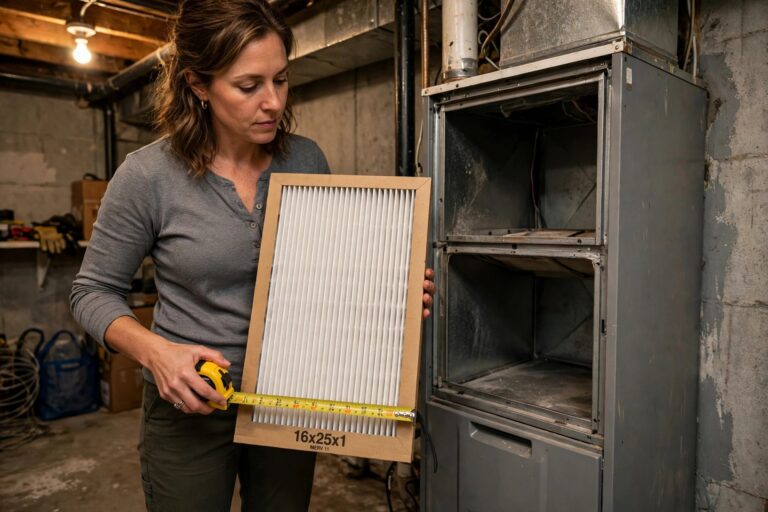
- Read the old filter’s frame before you shop: write down its exact size, its MERV rating, and its depth, and buy the same size.
- Check your furnace manual for the manufacturer’s filter specification, and do not exceed it without a technician’s advice.
- Note the airflow arrow on the new filter’s frame and install it pointing toward the blower, following the manual.
- Check the filter monthly in heating season, keep vents and returns clear, and keep storage away from the furnace.
- Use the manufacturer’s manual for homeowner sections only: filter changes, thermostat settings, and vent checks.
What not to touch
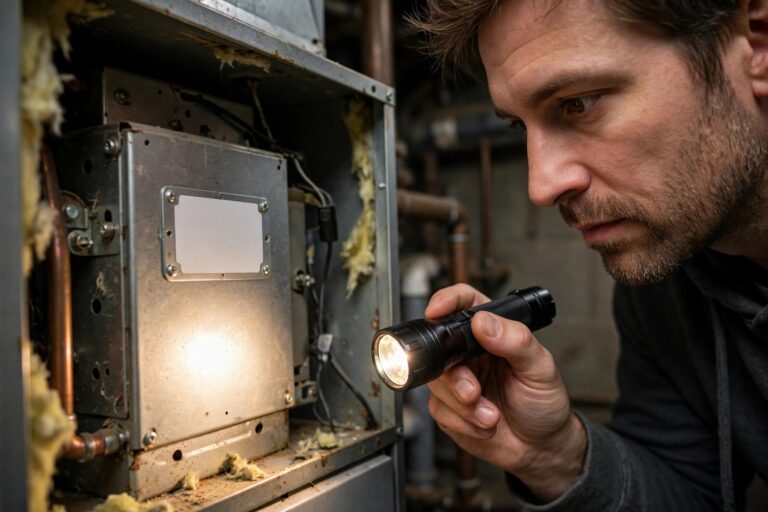
Do not open the burner compartment, adjust gas pressure, clean burners, or touch wiring inside the cabinet to test airflow or inspect a filter. Do not cut a larger filter slot, change the filter cabinet, or rewire the blower to force a higher MERV rating into a system that cannot take it. Do not run the furnace with no filter at all to “improve airflow”: unfiltered air fouls the coil and the heat exchanger.
In Ontario, gas appliance work must be performed by a TSSA-licensed technician, and refrigerant and high-voltage electrical work inside the cabinet belong to a licensed technician as well. If you are checking a technician’s credentials, the TSSA fuels contractor lookup is a public resource for gas work, and the EPA guide to MERV ratings is the source for the capture figures in this article.
Stop and call a licensed technician if
- You smell gas, your carbon monoxide alarm sounds, or anyone in the home has headaches, dizziness, or nausea that ease outdoors: leave the home and call 911 or your gas utility emergency line.
- Airflow at the vents drops sharply after switching to a higher MERV rating, or rooms that heated fine before now stay cold.
- The furnace short-cycles, locks out, or shows an error code after a filter change, despite a correctly sized, correctly installed filter.
- You want to move to MERV 13 or higher and your manual gives no filter rating, your slot is one inch deep, or your system is older and you are unsure what it can handle.
- The filter slot is damaged, the cabinet will not seal, or air is bypassing around the filter frame.
A MERV rating is a useful number, used the right way. It tells you which particles a filter can trap and how completely, it lets you compare filters fairly, and it turns a shelf full of boxes into a decision you can defend. It does not tell you whether a filter fits your furnace, whether your blower can handle it, or whether the air in your home is safe, and those questions are where a licensed technician earns their fee. If the job needs a pro, hire a TSSA-licensed technician and ask to see their licence before any gas work starts.
The Quality HVAC is an information and marketplace platform. We do not install, service, or repair HVAC equipment. Content here is educational only and is not a substitute for a licensed technician. In Ontario, gas appliance work must be performed by a TSSA-licensed technician. If you smell gas or your carbon monoxide alarm sounds, leave the home and call 911 or your gas utility emergency line.
Looking for equipment rather than a service? Browse the equipment marketplace for furnaces, filters, parts, and related items listed by sellers, or explore the heating tools collection for more plain-language guides.
One Comment