How to Read a Furnace Rating Plate: Model, BTU and AFUE Explained
How to Read a Furnace Rating Plate: Model, BTU and AFUE Explained
Table of Contents
A furnace rating plate is the small metal label on your furnace that states, in plain numbers, what the unit is and what it can do. It lists the model and serial number, the fuel it burns, how much heat goes in, how much useful heat comes out, and the clearances and electrical details the installer had to follow. If you ever need a part, a filter size, or a straight answer from a technician, the furnace rating plate is where that conversation starts.
Reading a furnace rating plate takes about five minutes, and you do not need to open any gas or electrical compartment to do it. This guide shows where to find the plate, what each field means, how to work out efficiency from the input and output numbers, and what the plate cannot tell you. Anything beyond reading the label, including gas, burner, and wiring work, belongs to a licensed technician.
Where to find the furnace rating plate
On most furnaces the rating plate sits inside the front access panel, on the side of the cabinet, or on the blower compartment door. Switch the furnace off at the thermostat first, then open only the outer front panel, the same panel you would open to change a filter. The plate is usually a silver, white, or yellow metal sticker with rows of small print. Take a photo of the whole plate with your phone, and a second close-up of the model and serial numbers, so you have the details handy without having to crouch in front of the furnace again.
If the plate is missing, painted over, or too worn to read, do not guess the numbers from a similar-looking furnace. Note the make, the approximate age, and anything else legible, and let a licensed technician identify the unit from its remaining markings. A wrong model number can lead to the wrong part, the wrong filter, or the wrong advice, so a missing furnace rating plate is itself a reason to get help.
Furnace rating plate fields, explained
Labels vary by manufacturer, but most furnace rating plate fields fall into the same groups. Here are the seven fields worth knowing, in the order you will usually meet them.
1. Manufacturer, model number, and serial number
The model number identifies the furnace design, while the serial number identifies your individual unit. Together they are the key to parts, manuals, and recall checks. When you call a technician or look up a manual, give both numbers exactly as printed, including letters, dashes, and zeros. Do not round them off or read them from memory.
2. Fuel type
The plate states whether the furnace burns natural gas, propane, oil, or uses electricity. This matters more than it looks: a furnace set up for natural gas must never be run on propane without the correct conversion kit and a licensed technician, and vice versa. If the fuel on the plate does not match what your home actually supplies, stop and get that checked before the furnace runs again.
3. Input BTU per hour
Input BTU per hour is how much fuel energy the furnace consumes at full fire. A common home furnace might show 60,000, 80,000, or 100,000 BTU per hour. This number describes fuel in, not heat delivered to your rooms, so a bigger input number does not automatically mean a warmer house. It mostly tells a technician whether the unit is sized in the right range for the home and the gas supply.
4. Output BTU per hour
Output BTU per hour is the useful heat the furnace delivers. Comparing output with input gives you the furnace efficiency in a rough, honest way: divide output by input and multiply by 100. For example, an 80,000 BTU input furnace with a 64,000 BTU output is running at about 80 percent efficiency. That quick check helps you understand a quote, because a replacement discussion should always compare output, not just input.
5. AFUE and efficiency
Many plates also print an AFUE figure, which stands for Annual Fuel Utilization Efficiency. AFUE is the tested seasonal efficiency of the furnace, accounting for start-up, cycling, and standby losses over a heating season, not just one steady burn. An older mid-efficiency furnace often sits near 80 percent AFUE, while a modern condensing furnace is typically 90 percent AFUE or higher. If the plate shows no AFUE, the input-to-output calculation above gives a close estimate, and the manufacturer’s manual for that model will state the rated AFUE.
6. Electrical ratings
The plate lists voltage, phase, and maximum current, and sometimes the blower motor details. These numbers matter when a breaker trips or a motor is replaced, because the wrong motor or breaker size can damage the unit. Homeowners do not need to act on these numbers, but photographing them saves a technician a return visit, and it stops a well-meaning swap with a part that does not match.
7. Clearances and certification marks
Finally, the plate states the minimum clearances to combustible materials, the venting type, and certification marks such as CSA. Clearances explain why boxes, paint cans, and storage must stay away from the furnace, and why a furnace squeezed into a closet without the stated space is a problem, not a space-saving win. If storage has crept up against the unit, moving it back to the stated clearance is one of the simplest safe checks a homeowner can do.
How to use the furnace rating plate in real life
Once you have the numbers, they answer practical questions. The model and serial numbers let you download the right manual and check whether a part fits. The input and output numbers let you sanity-check a replacement quote: if a proposed furnace has a much lower output than the old one, ask why, and if it has a much higher input, ask what changed about the home to justify it. The AFUE figure helps you compare running costs, because a jump from 80 percent to 96 percent AFUE means roughly 16 cents less fuel wasted on every dollar of heat, before duct losses are counted.
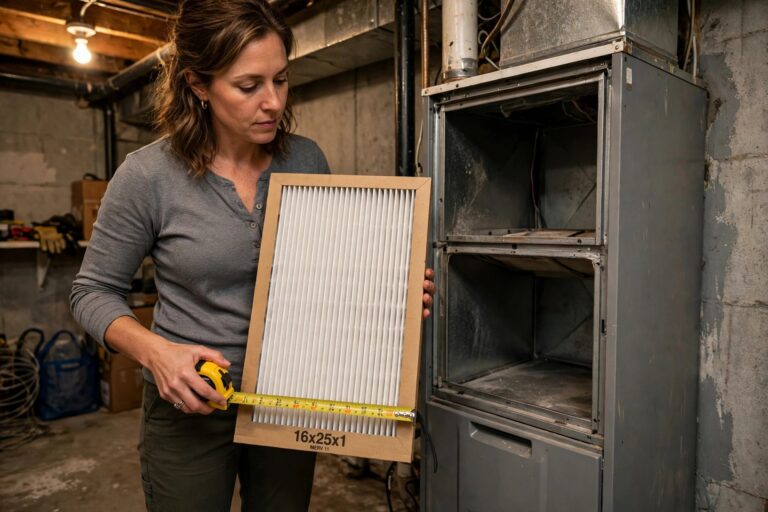
The plate also helps with the smaller jobs in the heating tools collection. Filter size, for example, is often printed on a separate label near the filter slot rather than on the rating plate itself, so check both labels while you are there. If your furnace is showing a fault, the furnace error codes guide explains the blinking light, and a blank thermostat has its own checks before you assume the furnace is at fault.
What a furnace rating plate does not tell you
The plate describes the furnace as it left the factory, not how it is performing today. It cannot tell you whether the heat exchanger is cracked, whether the burners are clean, whether the ductwork leaks, or whether the thermostat is reading correctly. A furnace can carry a 96 percent AFUE rating plate and still heat poorly if the filter is clogged, a duct is disconnected, or the gas pressure is wrong. The plate is a starting point for diagnosis, not a clean bill of health.
Age is another limit. Some manufacturers encode the year and week of manufacture in the serial number, but the code differs by brand and by era, so do not decode it from a general online chart and treat the result as fact. If the age matters for a repair-or-replace decision, ask a licensed technician to confirm it from the serial number and the manufacturer’s records.
Safe checks you can do yourself
- Photograph the whole furnace rating plate and the model and serial numbers, and keep the photos where you keep home records.
- Check that the fuel type on the plate matches your home’s fuel supply, and that nothing is stored within the stated clearances around the furnace.
- Work out the rough efficiency from output divided by input, and write it down next to the model number for future quotes.
- Use the model number to download the manufacturer’s manual, and follow only the homeowner sections: filter changes, thermostat settings, and vent checks.
- Keep the area around the furnace clear, the filter slot accessible, and the front panel properly seated after any check.
What not to touch
Do not remove the burner compartment cover, adjust gas pressure, clean burners, or touch wiring inside the cabinet to get a better look at the plate. Do not scrape, repaint, or cover the rating plate, and do not swap a part based on a model number you guessed from a similar unit. In Ontario, gas appliance work must be performed by a TSSA-licensed technician, and refrigerant and high-voltage electrical work inside the cabinet belong to a licensed technician as well. If you are checking a technician’s credentials, the TSSA fuels contractor lookup is a public resource for gas work.
Stop and call a licensed technician if
- The fuel type on the plate does not match your home’s fuel supply, or the plate is missing, damaged, or unreadable.
- The furnace rating plate shows a model or serial number that does not match the manual or parts a previous technician supplied.
- You smell gas, your carbon monoxide alarm sounds, or anyone in the home has headaches, dizziness, or nausea that ease outdoors: leave the home and call 911 or your gas utility emergency line.
- The furnace is red-tagged, locked out, or showing an error code you cannot clear with the homeowner steps in the manual.
- Storage, renovations, or a new wall have reduced the clearances below what the plate states.
- You are comparing replacement quotes and the proposed output, fuel type, or venting does not line up with what the plate and the home require.
A furnace rating plate will not fix a furnace, but it will stop a lot of guesswork. Photograph it, learn the seven fields, and bring the numbers to every service call and every quote. If the job needs a pro, hire a TSSA-licensed technician and ask to see their licence before any gas work starts.
The Quality HVAC is an information and marketplace platform. We do not install, service, or repair HVAC equipment. Content here is educational only and is not a substitute for a licensed technician. In Ontario, gas appliance work must be performed by a TSSA-licensed technician. If you smell gas or your carbon monoxide alarm sounds, leave the home and call 911 or your gas utility emergency line.
Looking for equipment rather than a service? Browse the equipment marketplace for furnaces, parts, and related items listed by sellers, and see the full symptoms library for what that noise, smell, or error code usually means.