
Table of Contents
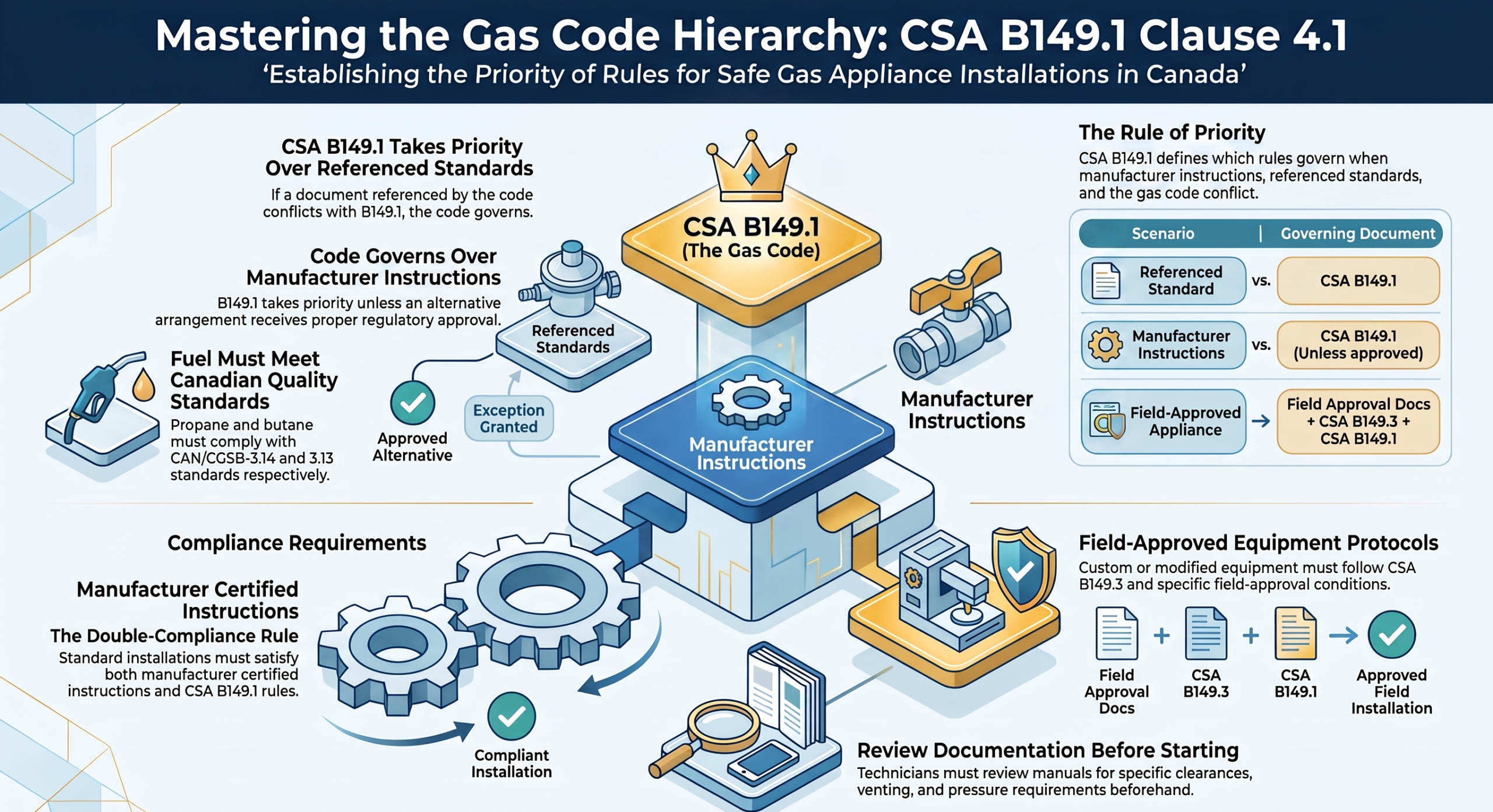
Clause 4.1 of CSA B149.1:25 establishes the general requirements that apply when installing natural gas and propane appliances, equipment, accessories, and components.
This clause is especially important for gas technicians because it explains:
- Which document takes priority when requirements conflict
- How manufacturer instructions must be followed
- How field-approved appliances must be installed
- When special approval may be required
Here is Clause 4.1 explained in practical terms, because code books apparently believe every simple rule deserves several layers of legal armour.

What Is CSA B149.1 Clause 4.1?
Clause 4.1 is titled Application. It establishes how the gas code applies alongside fuel standards, referenced documents, manufacturer instructions, and field approvals.
These requirements affect many types of gas-fired equipment, including:
- Furnaces
- Boilers
- Water heaters
- Rooftop units
- Unit heaters
- Commercial cooking equipment
- Other natural gas and propane appliances
Clause 4.1.1: Fuel Requirements
For the purposes of CSA B149.1, propane and butane must comply with the applicable Canadian fuel-quality standards.
The referenced standards are:
- CAN/CGSB-3.14 for propane
- CAN/CGSB-3.13 for butane
Practical meaning
The gas supplied to an appliance must meet the required quality and composition standards.
Fuel that is contaminated, improperly blended, or outside the applicable standard may affect combustion, appliance performance, reliability, and safety.
Field example
A propane appliance may experience poor ignition, unstable burner operation, or excessive deposits if the fuel supply does not meet the required standard. The appliance itself may be correctly installed, but the fuel quality can still cause serious operating problems.
Clause 4.1.2: Conflicts With Referenced Documents
CSA B149.1 references several other standards and technical documents.
When one of those referenced documents contains a requirement that conflicts with CSA B149.1, the requirement in CSA B149.1 governs.
Practical meaning
A referenced standard does not automatically override the gas code.
The technician must follow CSA B149.1 when a direct conflict exists, unless another clause or approval process specifically permits something different.
Field example
Suppose a referenced document permits an installation method, but CSA B149.1 places an additional restriction on that method. The technician must follow the CSA B149.1 requirement.
Key point
When CSA B149.1 conflicts with a document referenced by the code, CSA B149.1 takes priority.
Clause 4.1.3: Manufacturer’s Certified Installation Instructions
Gas appliances, equipment, components, and accessories must be installed according to:
- The manufacturer’s certified installation instructions
- CSA B149.1
Both requirements apply to the installation.
Practical meaning
The gas code provides general installation rules, while the manufacturer provides requirements specific to the appliance.
A compliant installation must satisfy both.
Manufacturer instructions may include requirements for:
- Clearances to combustible materials
- Venting systems
- Gas-supply pressure
- Electrical connections
- Drainage
- Combustion-air openings
- Appliance positioning
- Service access
- Conversion kits
- Approved accessories
Field example
A furnace manufacturer may require a particular vent material, maximum vent length, termination arrangement, or clearance.
Even when the general gas code allows the installation, the technician must also confirm that the installation meets the certified appliance instructions.
Important technician practice
The installation manual should be reviewed before beginning the installation, not after the equipment refuses to operate and everyone suddenly becomes interested in documentation.
Clause 4.1.4: Field-Approved Appliance Installation
A field-approved appliance or piece of equipment must be installed according to:
- The applicable field-approval requirements of CSA B149.3
- CSA B149.1
What is a field-approved appliance?
A field-approved appliance is generally equipment that does not have normal factory certification for its exact configuration but has been individually evaluated and approved for use at a particular installation.
This may apply to:
- Custom-built gas equipment
- Modified commercial appliances
- Imported equipment
- Industrial process equipment
- Appliances assembled from multiple components
- Equipment altered from its original certified design
Practical meaning
A technician cannot assume that custom or modified equipment is acceptable simply because it appears to operate correctly.
The appliance must have the required field approval, and the installation must follow both the field-approval conditions and CSA B149.1.
Field example
A custom commercial cooking appliance may be inspected and field approved for a specific location. The technician must install it according to the approval documentation and all applicable gas-code requirements.
Clause 4.1.5: Conflict Between Manufacturer Instructions and CSA B149.1
When the manufacturer’s certified instructions conflict with CSA B149.1, the requirements of the code take priority unless the alternative has been approved.
Practical meaning
Technicians are normally required to follow both the code and manufacturer instructions. However, when the two requirements directly contradict each other, CSA B149.1 governs unless approval has been obtained from the appropriate authority.
Field example
Suppose a manufacturer’s document shows an installation arrangement that does not meet a requirement of the current gas code.
The technician should not proceed simply because the arrangement appears in the manual. The code requirement must be followed unless the alternative installation has received proper approval.
Who may provide approval?
The exact approval process can depend on the province, territory, appliance, and type of installation.
The approving authority may include the applicable regulatory authority or another recognized authority having jurisdiction.
In Ontario, gas technicians should follow applicable TSSA requirements and any directions from the authority responsible for the installation.
Difference Between Clauses 4.1.2 and 4.1.5
These two clauses sound similar, but they address different kinds of conflicts.
Clause 4.1.2
This applies when CSA B149.1 conflicts with a standard or document referenced by the code.
Result: CSA B149.1 governs.
Clause 4.1.5
This applies when CSA B149.1 conflicts with the manufacturer’s certified installation instructions.
Result: CSA B149.1 governs unless the alternative is approved.
Practical Code-Hierarchy Guide
When reviewing an installation, use the following approach:
No conflict exists
Follow both:
- CSA B149.1
- The manufacturer’s certified installation instructions
A referenced standard conflicts with CSA B149.1
Follow CSA B149.1.
Manufacturer instructions conflict with CSA B149.1
Follow CSA B149.1 unless another arrangement has been properly approved.
The equipment is field approved
Follow:
- The field-approval documentation
- Applicable CSA B149.3 requirements
- CSA B149.1
Common Gas Technician Exam Questions
Question 1
What must an appliance be installed according to?
Answer: The manufacturer’s certified installation instructions and CSA B149.1.
Question 2
What happens when a referenced document conflicts with CSA B149.1?
Answer: CSA B149.1 takes priority.
Question 3
What happens when manufacturer instructions conflict with CSA B149.1?
Answer: CSA B149.1 takes priority unless the alternative has been approved.
Question 4
What standards apply to a field-approved appliance?
Answer: The applicable field-approval requirements of CSA B149.3 and CSA B149.1.
Question 5
Does following the manufacturer’s manual alone make an installation compliant?
Answer: No. The installation must comply with both the certified instructions and CSA B149.1.
Key Takeaways
- Clause 4.1 explains how CSA B149.1 works with other standards and manufacturer instructions.
- Propane and butane must meet their applicable Canadian fuel standards.
- CSA B149.1 governs when a referenced document conflicts with the code.
- Appliances must be installed according to both the gas code and certified manufacturer instructions.
- Field-approved equipment must comply with its field approval and the applicable gas codes.
- When manufacturer instructions conflict with CSA B149.1, the code governs unless another arrangement is approved.
Conclusion
CSA B149.1 Clause 4.1 establishes the basic hierarchy for gas-appliance installations.
The technician must not rely on only one source of information. A proper installation requires reviewing the gas code, certified manufacturer instructions, approval documents, and any other standards that apply.
Understanding this clause helps technicians make safer decisions, avoid failed inspections, and recognize when an installation requires additional approval.
Disclaimer
This article is intended for general education and exam preparation. Always consult the current official code, certified manufacturer instructions, local regulations, and the authority having jurisdiction before performing gas work.