
Gas Technician Glossary: Key Terms Every G3 Student and Homeowner Should Know
Whether you are studying for the Ontario G3 gas technician exam or just want to understand what your technician is talking about, this glossary explains 485 common gas-trade terms in plain English, with a real-world example for each. Terms are grouped by topic, following the CSA Gas Technician 3 curriculum.
This glossary is for general education. Exact requirements, clearances and values come from CSA B149.1, CSA B149.2, Ontario regulations and the appliance manufacturer’s instructions. Gas work in Ontario must be done by a TSSA-certified gas technician.
Contents
- Safety
- Tools, fasteners and test instruments
- Properties of gas and combustion
- Codes, regulations and TSSA
- Pressure and measurement
- Piping, tubing and fittings
- Regulators, valves and controls
- Electricity basics
- Appliances
- Venting and air supply
- Propane specifics
- Customer relations and technical manuals
Safety
PPE (Personal Protective Equipment)
Gear worn to protect the worker: safety glasses, gloves, CSA safety boots, hearing protection, hard hat.
Example: Wear safety glasses and gloves when cutting and reaming pipe.
WHMIS
Workplace Hazardous Materials Information System, Canada’s system for labelling hazardous products and training workers.
Example: Your employer must give you WHMIS training before you handle pipe dope solvents or leak-test chemicals.
GHS
Globally Harmonized System of classification and labelling; WHMIS 2015 is based on it.
Example: GHS pictograms (red diamond symbols) appear on propane cylinder labels.
SDS (Safety Data Sheet)
A document from the supplier listing a product’s hazards, safe handling, PPE and first aid.
Example: Check the SDS for the PVC cement before using it on a Category IV vent.
Supplier label
The WHMIS label the manufacturer puts on a hazardous product container.
Example: Never remove the supplier label from a can of leak-detection fluid.
Workplace label
A simpler WHMIS label used when a product is moved into a new container at the job site.
Example: If you pour solvent into a spray bottle, it needs a workplace label.
Pictogram
A GHS symbol inside a red diamond showing a hazard type, such as flame or gas cylinder.
Example: The flame pictogram on a propane label means flammable gas.
Flammable
Able to catch fire and burn easily.
Example: Natural gas and propane are flammable gases.
Combustible
Able to burn, but usually needing more heat to ignite than a flammable material.
Example: Keep combustible materials like cardboard away from the furnace.
Asphyxiant
A gas that can cause suffocation by displacing oxygen in the air.
Example: In a small room, a large gas leak can act as an asphyxiant.
Carbon monoxide (CO)
A colourless, odourless, poisonous gas produced by incomplete combustion.
Example: A blocked heat exchanger or vent can push CO into the house.
CO alarm
A device that sounds when CO in the air reaches a dangerous level.
Example: Ontario law requires CO alarms near sleeping areas in homes with fuel-burning appliances.
ppm (parts per million)
A unit used to measure small concentrations, such as CO in air or flue gas.
Example: The analyzer showed 35 ppm CO in the flue.
Lockout / tagout
Isolating an energy source (electrical or gas) and locking it off with a personal lock and tag so no one can turn it on while you work.
Example: Lock out the furnace disconnect before replacing the inducer motor.
Zero energy state
The condition after lockout when all stored energy has been released or blocked.
Example: Test the circuit with a meter to confirm zero energy before touching wires.
Confined space
A space not designed for people to occupy, with limited entry/exit, where hazardous atmospheres can build up.
Example: A crawl space with a gas meter may be treated as a confined space.
Hazard
Anything that can cause harm.
Example: A loose gas union is a hazard.
Risk
The chance that a hazard will cause harm, and how bad it could be.
Example: Working on a live gas line raises the risk of fire.
Hazard assessment
Identifying hazards on a job before starting and planning controls.
Example: Do a hazard assessment before entering an attic installation.
Fire triangle
The three things needed for fire: fuel, heat (ignition source) and oxygen.
Example: Shutting off the gas removes the fuel side of the fire triangle.
Class A fire
Fire involving ordinary combustibles like wood, paper and cloth.
Example: A water or ABC extinguisher can be used on a Class A fire.
Class B fire
Fire involving flammable liquids and gases like gasoline, oil, propane.
Example: A gas fire is Class B; shut off the gas supply first.
Class C fire
Fire involving energized electrical equipment.
Example: Never use water on a Class C fire in a furnace control panel.
Class D fire
Fire involving combustible metals such as magnesium.
Example: Class D fires need a special dry powder extinguisher.
Class K fire
Fire involving cooking oils and fats in commercial kitchens.
Example: Restaurant fryers need a Class K extinguisher.
Fire extinguisher (ABC)
A portable extinguisher rated for Class A, B and C fires.
Example: Keep an ABC extinguisher in the service van.

PASS
How to use an extinguisher: Pull, Aim, Squeeze, Sweep.
Example: Remember PASS: aim at the base of the flame.
First aid
Immediate care given to an injured person until medical help arrives.
Example: Report every injury, even minor cuts, and record first aid given.
WSIB
Workplace Safety and Insurance Board, Ontario’s workplace injury insurance.
Example: If you are hurt at work, your employer reports it to WSIB.
OHSA
Ontario’s Occupational Health and Safety Act, which sets duties for employers, supervisors and workers.
Example: Under OHSA, you have the right to refuse unsafe work.
Right to refuse
A worker’s legal right to refuse work they believe is dangerous.
Example: You can refuse to work in a trench with no shoring.
Ladder safety
Rules for using ladders, such as the 4-to-1 rule and 3-point contact.
Example: Set an extension ladder 1 foot out for every 4 feet up.
Fall protection
Equipment and methods (harness, guardrails) that prevent falls from height.
Example: Use fall protection when working on a roof near the edge.
Housekeeping
Keeping the work area clean and free of tripping hazards.
Example: Coil your hoses and pick up pipe scraps as you go.
Ventilation (work area)
Supplying fresh air to remove fumes or gas from a work area.
Example: Open doors to ventilate a room after a gas leak.
Gas detector (combustible)
An electronic instrument that detects flammable gas in air.
Example: Sweep the detector along the pipe joints to find a leak.
LEL (Lower Explosive Limit)
The lowest gas-in-air percentage that will burn; same as lower limit of flammability.
Example: Natural gas LEL is about 4–5% gas in air.
Hot work
Work that creates sparks or flames, such as soldering, brazing or cutting.
Example: Get a hot work permit before brazing in a commercial building.
Back injury prevention
Lifting with the legs, keeping loads close, and getting help with heavy items.
Example: Use two people to carry a boiler down the stairs.
Sound (noise) protection
Earplugs or earmuffs used where noise is high.
Example: Wear earplugs while using the pipe threading machine.
Static electricity
Electrical charge that builds up and can create a spark.
Example: Bond cylinders when transferring propane to prevent static sparks.
Emergency shut-off
Closing the main gas valve to stop flow in an emergency.
Example: Know where the meter shut-off is before starting a job.
Smell of gas procedure
Steps when gas is smelled: no sparks or switches, evacuate, shut off gas if safe, call from outside.
Example: The customer smelled gas, so we evacuated and called the gas utility from outside.
Tools, fasteners and test instruments
Pipe wrench
An adjustable wrench with serrated jaws that grip round pipe; used in pairs (one to hold, one to turn).
Example: Use two pipe wrenches so you don’t twist the line upstream.

Adjustable wrench
A smooth-jawed wrench with a movable jaw for nuts and fittings.
Example: Use an adjustable wrench on flare nuts, never a pipe wrench.
Open-end wrench
A fixed-size wrench with open jaws.
Example: A 5/8 inch open-end wrench fits many 3/8 flare nuts.
Flare-nut wrench
A wrench with a partly closed head that grips flare nuts without rounding them.
Example: Tighten the copper flare nut with a flare-nut wrench.
Pipe cutter
A tool with a cutting wheel that rotates around the pipe to cut it square.
Example: Cut the black iron pipe with a pipe cutter, then ream it.

Tubing cutter
A small cutter for copper or aluminium tubing.
Example: Use a tubing cutter on soft copper to keep the end round.
Reamer
A tool that removes the burr inside a cut pipe or tube.
Example: Always ream the pipe after cutting so the burr doesn’t restrict gas flow.
Burr
The rough edge left inside or outside a pipe after cutting.
Example: A burr inside the tube can damage the flare.
Pipe threader (die stock)
A tool with dies that cut tapered threads on pipe.
Example: Use cutting oil when threading pipe with the die stock.
Thread cutting oil
Oil used to cool and lubricate dies while threading.
Example: Too little cutting oil gives torn threads.
Pipe vise
A vise that holds pipe steady for cutting and threading.
Example: Clamp the pipe in a chain vise before threading.
Flaring tool
A tool that forms a 45° flared end on copper tubing for a flare fitting.
Example: Make a smooth 45° flare with the flaring tool.
Tube bender
A tool for bending tubing without kinking it.
Example: Use a tube bender for tight bends on 1/2 inch copper.
Pipe joint compound (pipe dope)
A sealant approved for gas, applied to male threads.
Example: Apply pipe dope to the male threads only, never the first two threads.
Thread sealing tape
PTFE tape for threads; must be yellow gas-rated tape where used for gas.
Example: Use yellow gas tape, not white plumbing tape.
Screwdriver (flat, Phillips, Robertson)
Hand tools for turning screws; Robertson (square) is common in Canada.
Example: Remove the furnace door with a Robertson screwdriver.
Nut driver
A screwdriver-style socket for hex-head screws.
Example: A 1/4 inch nut driver opens most furnace panels.
Pliers
Hand tools for gripping, bending and cutting wire.
Example: Use needle-nose pliers to pull a thermocouple lead.
Wire stripper
A tool that removes insulation from wire.
Example: Strip 1/2 inch of insulation before attaching to the terminal.
Hacksaw
A hand saw for cutting metal.
Example: Cut the B-vent with snips, not a hacksaw.
Tin snips (aviation snips)
Shears for cutting sheet metal.
Example: Cut the duct with aviation snips.
Drill and bits
Power tool for making holes.
Example: Drill a pilot hole before fastening the vent strap.
Fastener
Any hardware used to join or attach things: screws, bolts, nuts, anchors, rivets.
Example: Secure the vent connector with three sheet metal screws per joint.
Sheet metal screw
A self-tapping screw used on ducts and vent connectors.
Example: Fasten single-wall vent connector joints with sheet metal screws.
Machine screw
A screw used with a nut or tapped hole.
Example: The gas valve bracket uses machine screws.
Bolt
A threaded fastener used with a nut.
Example: Bolt the boiler to the stand.
Washer
A flat ring that spreads load under a nut or bolt.
Example: Put a washer under the nut.
Anchor
A fastener that holds in concrete, brick or drywall.
Example: Use concrete anchors to strap the pipe to the wall.
Pipe hanger / strap
Supports that hold piping in place at required spacings.
Example: Support the gas pipe with hangers so it doesn’t sag.
Rivet
A permanent fastener set with a rivet gun.
Example: Rivets are used on some sheet metal joints.
Manometer
An instrument that measures gas pressure, often in inches of water column; U-tube (liquid) or digital.
Example: Connect the manometer to the outlet tap of the gas valve to check manifold pressure.
U-tube manometer
A clear U-shaped tube with water; pressure is read as the total difference between the two columns.
Example: The water moved 2 inches down one side and 2 up the other: 4 in w.c.
Digital manometer
An electronic pressure gauge, often reading in in w.c., kPa or psi.
Example: Zero the digital manometer before connecting it.
Pressure gauge
A dial gauge that measures pressure, usually in psi or kPa.
Example: Use a 0–30 psi test gauge for the pressure test.
Multimeter
A meter that measures volts, amps, ohms and continuity.
Example: Check for 24 volts at the thermostat terminals with a multimeter.

Clamp-on ammeter
A meter that measures current by clamping around one wire.
Example: Clamp one wire to read the blower motor amps.
Microammeter
A meter that reads very small currents, used for flame rod signals.
Example: The flame signal read 3 microamps.
Millivolt meter
A meter or multimeter setting for small voltages, used on thermocouples and thermopiles.
Example: The thermocouple gave 25 mV with the pilot lit.
Voltage tester (non-contact)
A pen-type tester that lights up near live voltage.
Example: Check the wire with a non-contact tester before cutting it.
Combustion analyzer
An instrument that measures O2, CO, CO2, flue temperature and efficiency in flue gas.
Example: Use the combustion analyzer to confirm CO is low after setting up the burner.
Thermometer
An instrument that measures temperature.
Example: Measure supply and return air temperatures for temperature rise.
Draft gauge
A sensitive gauge that measures draft (negative pressure) in a vent.
Example: The draft gauge read −0.02 in w.c. at the draft hood.
Smoke pencil / match test
A small smoke source used to check spillage at a draft hood.
Example: Hold the smoke pencil at the draft hood relief opening to check spillage.
Leak detection solution
Approved bubble solution used to find gas leaks at joints.
Example: Brush leak solution on each new joint and look for bubbles.
Mirror and flashlight
Inspection tools for seeing behind appliances and inside burners.
Example: Use a mirror to look at the flame pattern.
Level
A tool that shows if something is horizontal or vertical.
Example: Level the water heater before connecting it.
Tape measure
A measuring tape.
Example: Measure the clearance from the vent to the combustible wall.
Torque
The turning force applied to a nut or fitting.
Example: Don’t over-torque flare nuts.
Socket set
Interchangeable sockets with a ratchet.
Example: Remove the burner bolts with a socket set.
Properties of gas and combustion
Natural gas
A fossil fuel gas, mainly methane, delivered by pipeline.
Example: Most Ontario homes use natural gas for heating.
Methane (CH4)
The main component of natural gas, lighter than air.
Example: Methane has one carbon and four hydrogen atoms.
Propane (C3H8)
An LP gas stored as a liquid under pressure, heavier than air.
Example: Rural homes often use propane from a tank.
Butane (C4H10)
An LP gas, heavier than propane, used in small cylinders.
Example: Butane is used in portable stoves.
LPG / LP gas
Liquefied petroleum gas: propane, butane or a mix.
Example: LP gas is stored as a liquid in cylinders.
Ethane
A hydrocarbon present in small amounts in natural gas.
Example: Natural gas contains a few percent ethane.
Hydrocarbon
A compound made of hydrogen and carbon; most fuel gases are hydrocarbons.
Example: Methane and propane are hydrocarbons.
Odorant
A chemical added to gas so leaks can be smelled.
Example: Utilities add odorant to natural gas.
Mercaptan
The sulphur-based odorant (rotten-egg smell) added to gas.
Example: Mercaptan lets customers smell a leak.
Odour fade
Loss of odorant smell, for example in new pipe, so a leak may not be noticed.
Example: Use a detector, not just your nose, because of odour fade.
Specific gravity
The weight of a gas compared with air (air = 1.0).
Example: Natural gas has a specific gravity of about 0.6, so it rises.
Density
Mass per unit volume.
Example: Propane vapour is denser than air.
BTU (British thermal unit)
The heat needed to raise 1 lb of water by 1 °F.
Example: The furnace input is 80,000 BTU/h.
BTU/h
Heat input or output rate in BTUs per hour; appliance ratings use it.
Example: Size the pipe for the total BTU/h of all appliances.
Joule / megajoule (MJ)
Metric units of energy.
Example: Natural gas is about 37–38 MJ per cubic metre.
Heating value
The amount of heat released by burning a unit of gas.
Example: Natural gas has about 1,000 BTU per cubic foot; propane about 2,500.
Gross (higher) heating value
Heating value including heat from condensing the water vapour in flue gases.
Example: Condensing furnaces recover part of the higher heating value.
Net (lower) heating value
Heating value without the heat of condensing water vapour.
Example: Non-condensing appliances only get the net heating value.
Cubic foot / cubic metre
Units of gas volume; meters measure in them.
Example: The meter reads in cubic metres.
Limits of flammability
The range of gas-in-air mixture that will burn.
Example: Natural gas burns between about 4% and 15% in air.
Upper explosive limit (UEL)
The highest gas-in-air percentage that will burn.
Example: Above UEL the mixture is too rich to burn.
Ignition temperature
The lowest temperature at which a gas-air mixture will ignite.
Example: Natural gas ignites at about 590–650 °C (1100–1200 °F).
Flame velocity
The speed at which a flame travels through a gas-air mixture.
Example: If gas velocity is lower than flame velocity, the flame flashes back.
Combustion
Rapid chemical reaction of fuel with oxygen, producing heat and light.
Example: Good combustion produces CO2 and water vapour.
Complete combustion
Burning where all fuel is fully oxidized to CO2 and H2O.
Example: Complete combustion gives a clear blue flame.
Incomplete combustion
Burning without enough air, producing CO, soot and aldehydes.
Example: A dirty burner caused incomplete combustion.
Primary air
Air mixed with gas before it reaches the burner port.
Example: Adjust the air shutter to set primary air.
Secondary air
Air that surrounds the flame and mixes at the flame.
Example: Secondary air enters around the burner.
Excess air
Air supplied above what is needed for perfect combustion, to ensure complete burning.
Example: Too much excess air lowers efficiency.
Theoretical (stoichiometric) air
The exact amount of air needed to burn the fuel completely; about 10 ft³ per ft³ of natural gas.
Example: Natural gas needs about 10 parts air to 1 part gas.
Air shutter
An adjustable plate controlling primary air into a burner.
Example: Open the air shutter to remove yellow tips.
Blue flame
A flame with good primary air; normal for atmospheric burners.
Example: A steady blue flame shows proper combustion.
Yellow flame
A flame lacking primary air, which can make soot and CO.
Example: Yellow flames mean you need more primary air or a cleaner burner.
Lifting flame
A flame that lifts off the port, from too much primary air or gas pressure.
Example: Lifting flames can go out and cause gas to escape.
Floating flame
A lazy, wandering flame from lack of air or poor venting.
Example: A floating flame suggests a blocked flue.
Flashback
When the flame burns back into the burner or mixing tube.
Example: Low gas pressure can cause flashback.
Inner cone
The bright blue inner part of a Bunsen-type flame.
Example: A sharp inner cone shows good mixing.
Flue gas (products of combustion)
The gases left after burning: CO2, water vapour, nitrogen, excess O2, and possibly CO.
Example: Flue gases must be vented outdoors.
Carbon dioxide (CO2)
A normal product of complete combustion.
Example: Flue CO2 for natural gas is often 8–9%.
Water vapour
Steam formed when hydrogen in fuel burns.
Example: Water vapour in flue gas can condense in a cold chimney.
Nitrogen
The main gas in air (about 78%); it passes through combustion mostly unchanged.
Example: Most of the flue gas is nitrogen.
Oxygen
The gas in air (about 21%) needed for combustion.
Example: The analyzer read 6% O2 in the flue.
Aldehydes
Irritating compounds from incomplete combustion, with a sharp smell.
Example: Aldehydes cause burning eyes near a bad appliance.
Soot
Black carbon deposits from incomplete combustion.
Example: Soot on the heat exchanger shows poor combustion.
Dew point
The temperature at which water vapour in flue gas condenses.
Example: Natural gas flue gas dew point is about 57 °C (135 °F).
Condensate
Liquid water formed when flue gas cools below dew point; slightly acidic.
Example: Drain the condensate from a high-efficiency furnace.
Latent heat
Heat absorbed or released when a substance changes state without changing temperature.
Example: Condensing appliances recover latent heat from water vapour.
Sensible heat
Heat that changes temperature and can be measured with a thermometer.
Example: Raising air temperature in the furnace is sensible heat.
Heat transfer
Movement of heat by conduction, convection or radiation.
Example: The heat exchanger transfers heat to the air.
Conduction
Heat transfer through direct contact.
Example: Heat moves through the metal wall by conduction.
Convection
Heat transfer by moving fluid or air.
Example: Warm air rises by convection.
Radiation
Heat transfer by infrared waves.
Example: An infrared heater warms people by radiation.
Efficiency
Useful heat output divided by heat input, as a percentage.
Example: A 95% furnace turns 95% of the gas energy into heat.
AFUE
Annual Fuel Utilization Efficiency, a seasonal furnace efficiency rating.
Example: A condensing furnace has an AFUE of 95% or more.
Temperature rise
Supply-air temperature minus return-air temperature across a furnace.
Example: Check that temperature rise is within the range on the rating plate.
Celsius / Fahrenheit
Temperature scales; water freezes at 0 °C / 32 °F.
Example: Convert 20 °C to 68 °F.
Expansion / contraction
Materials grow when heated and shrink when cooled.
Example: Allow for expansion of long vent runs.
Codes, regulations and TSSA
CSA B149.1
The Natural Gas and Propane Installation Code, the main code for gas installations in Canada.
Example: Look up venting clearances in CSA B149.1.
CSA B149.2
The Propane Storage and Handling Code.
Example: Cylinder storage distances are in B149.2.
CSA B149.5
Code for propane fuel systems on vehicles.
Example: Propane forklift systems fall under B149.5.
TSSA
Technical Standards and Safety Authority, which administers Ontario’s gas safety rules and certifies gas technicians.
Example: TSSA issues your G3 certificate.
O. Reg. 212/01
Ontario’s Gaseous Fuels regulation under the Technical Standards and Safety Act.
Example: O. Reg. 212/01 adopts the B149 codes in Ontario.
O. Reg. 215/01
Ontario’s Fuel Industry Certificates regulation, covering gas technician certificates.
Example: The scope of a G3 certificate is set out under O. Reg. 215/01.
Technical Standards and Safety Act
Ontario law that sets up TSSA and the fuel safety regulations.
Example: The Act gives TSSA inspectors their authority.
Code adoption document (CAD)
A TSSA document that adopts a code in Ontario with any Ontario changes.
Example: Check the CAD for Ontario amendments to B149.1.
Authority having jurisdiction (AHJ)
The organization responsible for enforcing the code in an area; in Ontario, TSSA for gas.
Example: The AHJ can approve an alternate installation.
Inspector
A person authorized by TSSA to inspect gas installations.
Example: The TSSA inspector checked the new boiler.
Certificate holder
A person holding a gas technician certificate (G1, G2, G3).
Example: Only a certificate holder may install gas piping.
G3 gas technician
Entry-level certificate allowing work under supervision of a G2 or G1 on certain tasks.
Example: A G3 works under the supervision of a G2 or higher.
G2 gas technician
Certificate covering appliances up to 400,000 BTU/h.
Example: A G2 can install a residential furnace.
G1 gas technician
Highest certificate, covering appliances of any input.
Example: A G1 can work on large industrial boilers.
Supervision
Work done under the direction of a qualified certificate holder.
Example: As a G3 you work under supervision.
Registered contractor
A business registered with TSSA to do gas work.
Example: Your employer must be a TSSA-registered contractor.
Approved
Accepted by the authority, usually by certification to a recognized standard.
Example: Use only approved appliances and components.
Certified / listed
Tested and labelled by an accredited agency (CSA, UL, ULC, ITS) as meeting a standard.
Example: Check the CSA label to confirm the valve is certified.
Appliance
A device that uses gas as fuel to produce heat, light or power.
Example: A furnace, water heater and range are all appliances.
Accessory
A part used with an appliance that isn’t the appliance itself, like a damper.
Example: A vent damper is an accessory.
Component
A part of the gas system such as a valve, regulator or control.
Example: Replace a faulty component with an approved one.
Accessible
Can be reached, but may require removing a panel or door.
Example: The valve is accessible behind the access panel.
Readily accessible
Can be reached quickly without removing obstacles or using a ladder.
Example: The manual shut-off valve must be readily accessible.
Shall
Code word meaning it’s mandatory.
Example: “Shall” in the code means you must do it.
Should
Code word meaning it’s recommended, not required.
Example: “Should” is advice, not a rule.
Definitions (code section)
The part of the code that gives the exact meaning of defined terms.
Example: Look up “vent connector” in the definitions section.
Annex
An informational section at the back of a code, not mandatory unless stated.
Example: Pipe sizing tables are in an annex.
Clause
A numbered paragraph in the code.
Example: Quote the clause when explaining a violation to a customer.
Manufacturer’s certified instructions
The installation instructions supplied with an appliance; they must be followed.
Example: The manual’s clearances are part of the approval.
Rating plate
The label on an appliance showing model, input, gas type, pressures and clearances.
Example: Check the rating plate for the gas type before connecting.
Input
The amount of gas energy an appliance uses, in BTU/h or kW.
Example: The input on the rating plate is 60,000 BTU/h.
Output
The useful heat an appliance delivers.
Example: Output is less than input because of losses.
Clearance
The required air space between an appliance or vent and combustible material.
Example: Look up the required clearance in the code or the appliance instructions before framing around the vent.
Combustible material
Material that can burn, such as wood, paper or drywall paper.
Example: Drywall is treated as combustible for clearances.
Non-combustible material
Material that will not burn, such as steel, brick or concrete.
Example: Use non-combustible material under a floor furnace.
Tag (unsafe condition)
A TSSA/utility tag placed on equipment found unsafe.
Example: The utility red-tagged the water heater for spillage.
Red tag
Tag for an immediate hazard; gas is shut off.
Example: A cracked heat exchanger got a red tag.
Yellow tag / warning
Tag for a non-immediate hazard that must be fixed.
Example: A missing sediment trap may get a warning tag.
Record of work
Documentation of the work done and tests performed.
Example: Fill in the record of the pressure test.
Utility (gas distributor)
The company that delivers gas to the meter, e.g. Enbridge Gas.
Example: Call the utility to turn on the meter.
Meter
The device that measures gas used by the building.
Example: The meter is owned by the utility.

Point of delivery
Where the utility’s system ends and the customer’s piping begins, usually the meter outlet.
Example: Everything after the point of delivery is customer piping.
Customer (house) piping
Gas piping from the point of delivery to the appliances.
Example: You are responsible for the house piping you install.
Pressure and measurement
Pressure
Force per unit area.
Example: Gas pressure pushes gas through the pipe.
psi (pounds per square inch)
Imperial unit of pressure.
Example: The pressure test was done at 15 psi.
psig
Gauge pressure in psi, measured above atmospheric pressure.
Example: A 2 psig system is common in some new homes.
psia
Absolute pressure in psi, gauge pressure plus atmospheric (about 14.7 psi).
Example: 0 psig equals about 14.7 psia.
kPa (kilopascal)
Metric unit of pressure; 1 psi is about 6.895 kPa.
Example: Natural gas house pressure is about 1.7 kPa (7 in w.c.).
Inches of water column (in w.c.)
Pressure measured by how high it pushes a column of water; 27.7 in w.c. = 1 psi.
Example: Natural gas supply is around 7 in w.c.; propane about 11 in w.c.
Atmospheric pressure
The pressure of the air around us, about 101.3 kPa (14.7 psi) at sea level.
Example: An atmospheric burner uses room-air pressure.
Gauge pressure
Pressure measured above atmospheric pressure.
Example: Most gas gauges read gauge pressure.
Absolute pressure
Pressure measured from a perfect vacuum.
Example: Absolute = gauge + atmospheric.
Vacuum / negative pressure
Pressure below atmospheric.
Example: A furnace room under negative pressure can cause spillage.
Static pressure
Pressure in the gas line with no gas flowing.
Example: Static inlet pressure read 7.5 in w.c. with all appliances off.
Dynamic (flowing / operating) pressure
Pressure while gas is flowing.
Example: Inlet pressure dropped to 6.5 in w.c. when the furnace fired.
Inlet (supply) pressure
Gas pressure entering the appliance valve.
Example: Measure inlet pressure at the valve’s inlet tap.
Manifold (outlet) pressure
Gas pressure leaving the gas valve to the burners.
Example: Natural gas manifold pressure is often about 3.5 in w.c.
Pressure drop
Loss of pressure due to friction as gas flows through pipe and fittings.
Example: Pipe sizing tables allow a 0.5 in w.c. pressure drop.
Pressure tap
A small plugged opening on a valve or pipe for connecting a gauge.
Example: Remove the plug on the outlet pressure tap to connect the manometer.
Pressure conversion
Changing between units: 1 psi = 27.7 in w.c. = 6.895 kPa; 1 kPa ≈ 4 in w.c.
Example: 14 in w.c. is about 0.5 psi.
Clocking a meter
Timing the meter dial to calculate actual gas input of an appliance.
Example: Clock the meter to confirm the furnace fires at its rated input.
Test dial
The smallest dial on a gas meter used for clocking.
Example: Time one revolution of the test dial.
Volume
The amount of space a gas occupies.
Example: Gas volume changes with pressure and temperature.
Flow rate
Volume of gas moving per unit time, such as ft³/h.
Example: The pipe must carry the total flow rate.
Boyle’s law
At constant temperature, gas volume goes down as pressure goes up.
Example: Compressing propane vapour reduces its volume.
Charles’ law
At constant pressure, gas volume increases as temperature increases.
Example: Gas expands when heated.
Imperial / SI units
The two measurement systems used in the trade; B149 uses both.
Example: Know both inches and millimetres for the exam.
Area
The size of a surface, in in² or m².
Example: Combustion air openings are sized by free area.
Free area
The open area of a grille or louvre after allowing for the bars.
Example: Wood louvres have only about 25% free area.
Piping, tubing and fittings
Black iron (steel) pipe
Schedule 40 steel pipe, the common threaded gas pipe.
Example: Run the main in 3/4 inch black iron pipe.
Schedule 40
Standard pipe wall thickness for steel gas pipe.
Example: Use Schedule 40 pipe for threaded gas lines.
Galvanized pipe
Zinc-coated steel pipe; check code and local rules before using for gas.
Example: Galvanized is used outdoors where allowed.
Copper tubing
Seamless tubing (type K, L or G) used for gas with flare fittings.
Example: Connect the range with soft copper tubing.
Type G copper
Copper tubing made and marked for gas use (often yellow-jacketed).
Example: Type G tubing is marked for gas.
CSST (Corrugated Stainless Steel Tubing)
Flexible stainless tubing with a yellow (or black) jacket, installed with the maker’s fittings.
Example: CSST must be bonded according to the manufacturer’s instructions.
PE (polyethylene) pipe
Plastic pipe used underground outdoors only.
Example: The underground service is yellow PE pipe.
Tracer wire
A wire buried with plastic pipe so it can be located later.
Example: Install tracer wire along the PE pipe.
Appliance connector (flex connector)
A certified flexible connector between the gas outlet and an appliance.
Example: Use a new certified connector for the dryer.
Nominal size
The trade size of pipe, not its exact measurement.
Example: 1/2 inch nominal pipe is about 0.84 inch outside diameter.
OD / ID
Outside diameter / inside diameter.
Example: Copper tubing is sized by OD.
NPT (National Pipe Thread, tapered)
The tapered thread standard used on gas pipe; it seals as it tightens.
Example: Gas pipe uses NPT threads.
Thread engagement
How many threads go into the fitting when tight.
Example: Too short a thread gives poor engagement and leaks.
Fitting
A part that joins pipe: elbow, tee, coupling, union, etc.
Example: Count the fittings when sizing the pipe.
Elbow (ell)
A fitting that changes direction, usually 90° or 45°.
Example: Use a 90° elbow to turn up the wall.
Street elbow
An elbow with one male and one female end.
Example: A street ell saves a nipple in tight spots.
Tee
A fitting with three openings for a branch.
Example: Install a tee to branch to the water heater.
Coupling
A fitting joining two pipes in a straight line.
Example: Use a coupling to extend the pipe.
Reducer / reducing coupling
A fitting joining pipes of different sizes.
Example: Reduce from 3/4 to 1/2 inch at the furnace.
Bushing
A fitting that screws inside another to reduce size.
Example: Avoid stacking bushings.
Nipple
A short length of pipe threaded on both ends.
Example: Use a 6 inch nipple for the drip leg.
Close nipple
A nipple threaded along its whole length.
Example: A close nipple joins two fittings with no gap.
Cap
A fitting that screws over a male-threaded pipe end to close it.
Example: Put a cap on the end of the sediment trap.
Plug
A fitting that closes a female-threaded opening.
Example: Plug the unused tee outlet.
Union
A fitting that lets you disconnect pipe without turning it, with a ground joint.
Example: Install a union near the appliance for service.
Ground joint union
A union that seals metal-to-metal without a gasket.
Example: Don’t put dope on the ground joint face.
Flare fitting
A fitting that seals copper tubing with a 45° flare and nut.
Example: Copper gas tubing is normally joined with 45° flare fittings.

Flare nut
The nut that holds the flared tube against the fitting.
Example: Slide the flare nut on before flaring the tube.
Compression fitting
A fitting with a ferrule; generally not allowed for gas.
Example: Don’t use a compression fitting on gas tubing unless it is certified for gas.
Manual shut-off valve
A hand valve to shut off gas; required for each appliance.
Example: Install a manual shut-off valve upstream of the union.
Quarter-turn ball valve
A shut-off valve that opens or closes with a 90° turn.
Example: The handle across the pipe means closed.
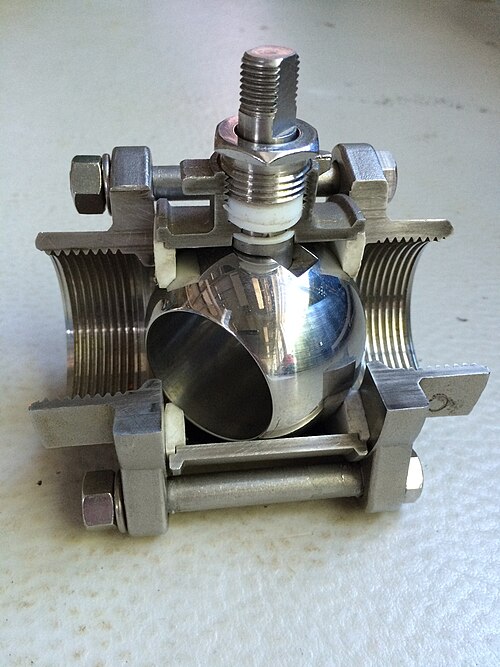
Plug valve (gas cock)
A tapered-plug shut-off valve.
Example: Old installations have plug valves.
Sediment trap (drip leg)
A short capped pipe below the appliance gas inlet that catches dirt and moisture.
Example: Install a sediment trap before the furnace gas valve.
Drip
A trap in piping to collect condensate in wet gas or low points.
Example: Install a drip at the low point.
Pipe sizing
Choosing pipe diameter for the BTU load, length and allowed pressure drop.
Example: Use the longest run method from the code tables.
Longest length method
Sizing every section using the length from the meter to the farthest outlet.
Example: The farthest appliance is 60 feet away, so use the 60 foot column.
Equivalent length
Pipe length plus an allowance for fittings.
Example: Add equivalent length for each elbow.
Main / branch / drop
Main is the trunk line; branch feeds an appliance; drop goes down to it.
Example: The drop to the dryer is 1/2 inch.
Riser
A vertical section of pipe going up.
Example: The meter riser comes up out of the ground.
Pipe support spacing
Maximum distance between hangers depending on pipe size.
Example: Check the code table for the maximum hanger spacing for each pipe size.
Concealed piping
Piping hidden in walls or floors.
Example: No unions are allowed in concealed piping.
Sleeve
A larger pipe around gas pipe where it passes through a wall or floor.
Example: Sleeve the gas pipe through the foundation wall.
Pressure test (leak test)
Pressurizing new piping with air or inert gas and checking it holds for a set time.
Example: Pressure-test the new piping before connecting appliances.
Test medium
The gas used for the pressure test: air, nitrogen or CO2, never oxygen.
Example: Never use oxygen as the test medium.
Test duration
How long the test pressure must be held.
Example: Hold the test for the time in the code table without any drop.
Purging
Removing air from a gas line (or gas from a line) safely before use or service.
Example: Purge the new line to the outdoors until gas is present.
Bonding
Connecting metal piping electrically to the building ground to prevent shock or arcing.
Example: Bond the CSST with a bonding clamp near the meter.
Grounding
Connecting electrical systems to the earth.
Example: Never use the gas pipe as the electrical ground.
Dielectric union
A union with insulation that separates dissimilar metals to prevent corrosion.
Example: Use a dielectric union between copper and steel water lines.
Corrosion
Deterioration of metal by chemical reaction, e.g. rust.
Example: Paint exposed outdoor steel pipe to prevent corrosion.
Cathodic protection
A method of preventing corrosion of buried steel pipe.
Example: Buried steel services have cathodic protection.
Hydrostatic
Relating to liquid pressure; used for tank tests.
Example: Propane tanks get hydrostatic tests.
Regulators, valves and controls
Regulator
A device that reduces gas pressure and keeps it steady.
Example: The service regulator drops line pressure to 7 in w.c.
Service regulator
The utility’s regulator at the meter that reduces street pressure to house pressure.
Example: The service regulator is next to the meter.
Line (system) regulator
A regulator in the house piping that reduces elevated pressure (e.g. 2 psi) for appliances.
Example: A line regulator drops 2 psi to 7 in w.c. for the furnace.
Appliance regulator
A regulator, often built into the gas valve, that sets manifold pressure.
Example: Adjust the appliance regulator to the manifold pressure on the rating plate.
Diaphragm
A flexible membrane in a regulator or valve that moves with pressure.
Example: A torn diaphragm causes the regulator to leak.
Spring (regulator)
Pushes on the diaphragm; its setting determines outlet pressure.
Example: Turn the adjusting screw to change spring tension.
Adjusting screw
The screw that changes regulator spring tension and outlet pressure.
Example: Remove the cap to reach the adjusting screw.
Vent (regulator)
The opening that lets the regulator breathe air in and out above the diaphragm.
Example: Keep the regulator vent free of ice and insects.
Vent limiter
A device in the regulator vent that limits gas escape if the diaphragm breaks, allowing indoor install without venting outdoors.
Example: A vent limiter lets the line regulator be installed indoors.
Lockup
The pressure at which a regulator fully closes when there is no flow.
Example: Check that lockup isn’t too high.
Droop
A drop in regulator outlet pressure as flow increases.
Example: Too small a regulator shows droop at full fire.
Overpressure protection
Devices that prevent downstream pressure going too high, like relief valves.
Example: The service has overpressure protection.
Relief valve
A valve that opens to release pressure above its setting.
Example: The propane tank relief valve opened on a hot day.
Gas valve (combination gas control)
The appliance control that includes a manual valve, pilot safety, regulator and automatic valve in one body.
Example: Replace the combination gas valve if it won’t open with 24 V applied.
Solenoid valve
An electrically opened valve, closed by a spring when de-energized.
Example: The solenoid clicks open when 24 V is applied.
Automatic valve
A valve opened and closed by a control signal.
Example: The thermostat call opens the automatic valve.
Redundant valve
Two valve seats in series in one gas control for extra safety.
Example: Most modern gas valves are redundant.
Pilot
A small flame that lights the main burner.
Example: Light the pilot and hold the knob for 30 seconds.

Standing pilot
A pilot that burns continuously.
Example: Older water heaters have a standing pilot.
Intermittent pilot (IPI)
A pilot lit by spark only when there is a call for heat.
Example: An intermittent pilot saves gas.
Pilot safety (flame safeguard)
A system that shuts off gas if the flame is not proven.
Example: The pilot safety shut the gas off when the pilot went out.
Thermocouple
Two dissimilar metals joined at a tip that produce millivolts when heated by the pilot; holds the safety valve open.
Example: Replace the thermocouple if it produces under the required millivolts.
Thermopile
Many thermocouples in series producing more millivolts (e.g. 750 mV) to power a gas valve.
Example: A gas fireplace uses a thermopile and no house power.
Power unit (magnet)
The electromagnet in a gas valve held by thermocouple current.
Example: If the power unit is weak, the pilot won’t stay on.
Flame rod (flame sensor)
A metal rod in the flame that proves flame by flame rectification.
Example: Clean the flame sensor with fine abrasive pad.
Flame rectification
Flame conducts and rectifies AC to DC microamps, proving flame.
Example: No ground at the burner prevents flame rectification.
Ignition control module
The electronic board that controls ignition sequence and flame proving.
Example: The ignition module locked out after three tries.
Spark igniter
An electrode that sparks to light the pilot or burner.
Example: Check the spark gap on the igniter.
Hot surface igniter (HSI)
A silicon carbide or nitride element that glows hot to light gas.
Example: Don’t touch the HSI with your fingers.
Direct spark ignition (DSI)
Spark lights the main burner directly without a pilot.
Example: DSI is common in boilers.
Lockout (control)
The control shuts down and won’t retry until reset after failing to prove flame.
Example: The module went into lockout after failed ignition.
Trial for ignition
The time allowed for the flame to be proven before the control shuts off gas.
Example: A 4-second trial for ignition.
Purge period (prepurge/postpurge)
Running the inducer before or after firing to clear the combustion chamber.
Example: The inducer runs a prepurge before ignition.
Thermostat
A control that turns heating on and off to maintain room temperature.
Example: The thermostat closes R to W on a call for heat.
Heat anticipator
A small heater in old thermostats to prevent overshoot.
Example: Set the anticipator to the gas valve current.
Limit switch (high limit)
A safety switch that shuts off the burner if the temperature gets too high.
Example: A dirty filter tripped the high limit.
Rollout switch
A safety switch near the burner that trips if flames roll out of the combustion chamber.
Example: A blocked heat exchanger tripped the rollout switch.
Pressure switch
A switch that proves the inducer is moving air (draft) before ignition.
Example: A blocked vent kept the pressure switch open.
Fan control
A control that turns the blower on and off by time or temperature.
Example: The fan control starts the blower after 60 seconds.
Spill switch (blocked vent switch)
A safety switch at a draft hood that shuts the appliance off on spillage.
Example: The spill switch tripped because the chimney was blocked.
Vent damper
An automatic damper in the vent that closes when the appliance is off.
Example: The vent damper must be proven open before firing.
Draft inducer (inducer motor)
A fan that pulls combustion products through the heat exchanger.
Example: The inducer starts first on a call for heat.
Aquastat
A temperature control for water in a boiler.
Example: Set the boiler aquastat to 180 °F.
Thermal cutoff (ECO)
A one-time or resettable temperature safety switch, e.g. on water heaters.
Example: The ECO on the water heater opened.
Sequence of operation
The step-by-step order in which a control system works.
Example: Learn the furnace sequence: thermostat, inducer, pressure switch, ignition, gas valve, flame proof, blower.
Electricity basics
Electricity
The flow of electrons through a conductor.
Example: Furnace controls need electricity to operate.
Voltage (volt, V)
Electrical pressure that pushes current.
Example: Furnace control voltage is 24 volts.
Current (ampere, A)
The flow rate of electrons.
Example: The blower motor draws 5 amps.
Resistance (ohm, Ω)
Opposition to current flow.
Example: A good HSI reads about 40–90 ohms.
Ohm’s law
Voltage = current × resistance (E = I × R).
Example: 24 V across 12 Ω gives 2 A.
Power (watt, W)
The rate of electrical energy use: watts = volts × amps.
Example: A 120 V, 5 A motor uses about 600 W.
Circuit
A complete path for current: source, load, conductors and a control.
Example: Opening the switch breaks the circuit.
Open circuit
A broken circuit with no current flow.
Example: A broken thermocouple lead is an open circuit.
Closed circuit
A complete circuit where current flows.
Example: The switch closed and the circuit is complete.
Short circuit
An unintended low-resistance path, causing high current.
Example: A pinched wire caused a short and blew the fuse.
Series circuit
Components connected one after another in one path; current is the same through each.
Example: Safety switches are wired in series with the gas valve.
Parallel circuit
Components on separate branches; voltage is the same across each.
Example: House outlets are wired in parallel.
Load
A device that uses electricity, like a motor or valve.
Example: The gas valve is a load.
Switch
A device that opens or closes a circuit.
Example: The limit switch opens on high temperature.
Conductor
Material that lets electricity flow easily, like copper.
Example: Copper wire is a good conductor.
Insulator
Material that resists electricity, like plastic or rubber.
Example: Wire insulation prevents shocks.
AC (alternating current)
Current that reverses direction many times per second (60 Hz in Canada).
Example: House power is 120 V AC.
DC (direct current)
Current that flows in one direction.
Example: A thermocouple produces DC.
Hertz (Hz)
Cycles per second.
Example: Canada uses 60 Hz.
Transformer
A device that changes AC voltage up or down, e.g. 120 V to 24 V.
Example: The furnace transformer supplies 24 V to the controls.
Primary / secondary (transformer)
Primary is the input side; secondary is the output side.
Example: Measure 24 V on the secondary.
VA rating
A transformer’s capacity in volt-amps.
Example: A 40 VA transformer is common in furnaces.
Relay
An electrically operated switch using a coil to open or close contacts.
Example: The fan relay turns on the blower.
Contacts (NO/NC)
The switching parts of a relay or switch; normally open or normally closed.
Example: A normally open contact closes when the coil is energized.
Coil
A wire winding that creates a magnetic field when energized.
Example: The relay coil is energized by 24 V.
Fuse
A safety device that melts and opens a circuit on overcurrent.
Example: Replace the 3 A fuse on the control board.
Circuit breaker
A resettable switch that trips on overcurrent.
Example: Turn off the breaker before working on the furnace.
Ground (earth)
A path to earth for safety.
Example: The green wire is the ground.
Neutral
The current-carrying return conductor, white in Canada.
Example: Don’t mix up hot and neutral.
Hot (line)
The live conductor, usually black or red.
Example: The black wire is hot.
Polarity
Correct connection of hot and neutral.
Example: Reversed polarity can stop flame sensing.
Continuity
A complete path; a meter beeps or shows near zero ohms.
Example: Check the limit switch for continuity.
Capacitor
A device that stores electrical charge, used to start or run motors.
Example: A weak run capacitor makes the blower slow.
Motor
A device that turns electricity into rotation.
Example: The blower motor moves air through the furnace.
ECM motor
Electronically commutated motor, a variable-speed efficient motor.
Example: New furnaces use ECM blowers.
Wiring diagram (schematic / ladder)
A drawing that shows how components are connected.
Example: Follow the ladder diagram to trace the fault.
Disconnect switch
A switch that cuts power to an appliance for service.
Example: The furnace disconnect is on the side of the unit.
Electrical Safety Authority (ESA)
Ontario’s electrical safety regulator.
Example: Line-voltage wiring work may require ESA notification.
Appliances
Furnace
An appliance that heats air and blows it through ducts.
Example: Most Ontario homes use a forced-air gas furnace.
Forced-air furnace
A furnace using a blower to move air.
Example: A forced-air furnace has a blower and filter.
Upflow / downflow / horizontal
Furnace configurations by direction of airflow.
Example: Basement furnaces are usually upflow.
Mid-efficiency furnace
A non-condensing furnace (about 80% AFUE) with an inducer.
Example: A mid-efficiency furnace vents into B-vent.
High-efficiency (condensing) furnace
A furnace of 90%+ AFUE that condenses flue gases and vents in plastic pipe.
Example: A condensing furnace needs a condensate drain.
Boiler
An appliance that heats water or makes steam for heating.
Example: The hot water boiler feeds the radiators.
Hydronic
Heating with hot water through pipes.
Example: In-floor heating is a hydronic system.
Water heater (storage tank)
An appliance that heats and stores domestic hot water.
Example: A 40 gallon gas water heater.
Tankless (instantaneous) water heater
A water heater that heats water only as it flows.
Example: Tankless heaters need large gas input.
Range / cooktop / oven
Cooking appliances.
Example: Check the range burners for proper flame.
Clothes dryer
An appliance that dries clothes using gas heat.
Example: A gas dryer needs a certified connector.
Fireplace / room heater
Decorative or heating appliances in living spaces.
Example: A direct-vent fireplace uses a sealed glass front.
Unit heater
A suspended heater with a fan used in garages and shops.
Example: Hang the unit heater in the garage.
Infrared (radiant) heater
A heater that warms objects by radiation.
Example: Infrared tube heaters in a warehouse.
Pool heater
An appliance that heats pool water.
Example: Pool heaters are installed outdoors.
Barbecue
An outdoor cooking appliance.
Example: Connect the BBQ to the outdoor gas outlet.
Heat exchanger
The part that transfers heat from flame or flue gases to air or water without mixing them.
Example: A cracked heat exchanger can leak CO.
Primary / secondary heat exchanger
In a condensing furnace, the first one takes sensible heat, the second condenses flue gas.
Example: The secondary heat exchanger produces condensate.
Combustion chamber
The space where gas burns.
Example: Look inside the combustion chamber for rollout.
Burner
The part that mixes gas and air and holds the flame.
Example: Clean the burners during maintenance.
Atmospheric burner
A burner that uses natural draft for air.
Example: Older water heaters have atmospheric burners.
Power burner
A burner with a fan supplying combustion air.
Example: Commercial boilers often have power burners.
Inshot burner
A burner that fires horizontally into the heat exchanger tubes.
Example: Most furnaces have inshot burners.
Burner port
The opening where the flame burns.
Example: Clogged burner ports make an uneven flame.
Orifice
A small drilled opening that controls gas flow into the burner.
Example: Change orifices when converting to propane.
Spud
The fitting that holds the orifice, screwed into the manifold.
Example: Replace the spud with the correct drill size.
Manifold
The pipe that distributes gas to the burner orifices.
Example: The manifold pressure tap is on the gas valve.
Venturi
The narrow section of a burner where gas flow draws in primary air.
Example: Gas speeding through the venturi pulls in air.
Conversion kit
Parts to change an appliance from natural gas to propane or back.
Example: Install the propane conversion kit and label the appliance.
Derating
Reducing appliance input, for example at high altitude.
Example: Derate input above 2,000 feet.
Blower
The fan that moves air through the furnace and ducts.
Example: Set the blower speed for proper temperature rise.
Air filter
Removes dust from return air.
Example: A plugged filter causes high limit trips.
Supply / return air
Supply delivers heated air; return brings room air back.
Example: Measure temperature in the supply and return.
Plenum
The box on the furnace connecting to supply or return ducts.
Example: Install the humidifier on the supply plenum.
Duct
Pipe that carries air.
Example: Seal the duct joints.
Cabinet
The outer metal case of an appliance.
Example: The cabinet must be closed when running.
Flame roll-out
Flames escaping from the combustion chamber.
Example: Flame roll-out can burn wiring.
Anode rod
A sacrificial rod in a water heater tank that prevents corrosion.
Example: Replace the anode rod when it’s worn.
Dip tube
A tube that carries cold water to the bottom of the tank.
Example: A broken dip tube gives lukewarm water.
T&P (temperature and pressure) relief valve
A water heater valve that opens if temperature or pressure gets too high.
Example: Pipe the T&P discharge line down toward the floor as the instructions require.
Expansion tank
A tank that absorbs expansion of heated water.
Example: Install an expansion tank on the boiler.
Circulator pump
A pump that circulates water in a hydronic system.
Example: The circulator moves water to the radiators.
Direct vent appliance
An appliance that takes all combustion air from outdoors and vents outdoors through a sealed system.
Example: A direct vent furnace uses two pipes.
Sealed combustion
The combustion system is sealed from the room.
Example: Sealed combustion appliances don’t use room air.
Maintenance
Regular cleaning and checking to keep an appliance safe and efficient.
Example: Do annual maintenance before winter.
Venting and air supply
Venting
Carrying flue gases from an appliance to the outdoors.
Example: Proper venting removes CO from the home.
Vent / venting system
The pipes or passage that carry flue gases outdoors.
Example: The venting system must be continuous to outdoors.
Vent connector
The pipe that connects the appliance flue outlet or draft hood to the vent or chimney.
Example: Slope the vent connector up toward the chimney.
Flue
The passage inside an appliance or chimney through which flue gases flow.
Example: The flue collar is on top of the water heater.
Flue collar
The part of the appliance where the vent connector attaches.
Example: Fasten the vent connector to the flue collar.
Chimney
A vertical masonry or factory-built structure that carries flue gases.
Example: The water heater vents into a masonry chimney.
Chimney liner
A metal liner inside a masonry chimney.
Example: Install a liner when the furnace is removed from a shared chimney.
Draft
The pressure difference that moves flue gases up the vent.
Example: Good draft pulls flue gases out of the draft hood.
Natural draft
Draft created by hot, light flue gases rising.
Example: A Category I water heater uses natural draft.
Mechanical (forced / induced) draft
Draft created by a fan.
Example: An induced draft fan pulls gases through the furnace.
Draft hood
A device on an appliance that lets room air mix with flue gases, stabilizes draft and prevents downdraft from affecting the burner.
Example: Check for spillage at the draft hood relief opening.
Barometric damper (draft regulator)
A swinging damper that lets room air in to control draft.
Example: Oil appliances use a barometric damper.
Dilution air
Room air drawn in at the draft hood to mix with flue gases.
Example: Dilution air enters the draft hood.
Combustion air
Air supplied for burning gas.
Example: Provide combustion air openings to the furnace room.
Ventilation air
Air that keeps the appliance room cool.
Example: Ventilation air removes heat from the room.
Spillage
Flue gases coming out of the draft hood into the room.
Example: Spillage for more than a few minutes means a venting problem.
Backdraft
Flue gases flowing back down the vent into the building.
Example: Exhaust fans can cause backdraft.
Downdraft
Air flowing down a chimney.
Example: Wind can cause downdraft.
Depressurization
The building under negative pressure from exhaust fans, causing venting problems.
Example: A kitchen fan caused house depressurization.
Worst-case test
Running exhaust fans to check if an appliance vents properly under depressurization.
Example: Do a worst-case spillage test after installing the water heater.
B-vent (Type B gas vent)
Double-wall factory-built vent with an air space, for Category I appliances.
Example: Use B-vent for the mid-efficiency furnace.
Single-wall vent
Single-layer galvanized pipe used for vent connectors only in allowed locations.
Example: Single-wall needs larger clearance to combustibles.
Category I appliance
Negative vent pressure, non-condensing.
Example: A mid-efficiency furnace is Category I.
Category II appliance
Negative vent pressure, condensing.
Example: Category II appliances are rare.
Category III appliance
Positive vent pressure, non-condensing.
Example: Category III uses a special sealed stainless vent.
Category IV appliance
Positive vent pressure, condensing; vented in plastic pipe like PVC/CPVC/PP (ULC S636).
Example: A 95% furnace is Category IV.
ULC S636
Standard for plastic venting systems.
Example: Use only ULC S636 certified PVC for venting.
PVC / CPVC / polypropylene vent
Plastic vent pipes for condensing appliances.
Example: Glue PVC vent joints with approved cement.
Concentric vent
A pipe-within-a-pipe termination for intake and exhaust.
Example: Use a concentric vent kit through the wall.
Vent termination
The end of the vent outdoors.
Example: Keep the termination away from windows.
Vent cap
A cap at the top of a vent to keep rain out and help draft.
Example: Install a listed vent cap on the B-vent.
Sidewall venting
Venting horizontally through a wall.
Example: Condensing furnaces usually vent through the sidewall.
Rise / slope
Upward slope of a vent connector toward the vent (often 1/4 inch per foot).
Example: Give the connector a rise toward the chimney.
Common venting
Venting two or more appliances into one vent.
Example: Furnace and water heater may share a common vent.
Orphaned water heater
A water heater left alone in a chimney after the furnace is removed; the chimney may be too big.
Example: Check the orphaned water heater for proper draft.
Vent sizing
Choosing vent diameter and height using code or manufacturer tables.
Example: Use the vent tables to size the common vent.
Thimble
A sleeve where the vent connector enters a chimney.
Example: Seal the thimble.
Cleanout
An opening at the base of a chimney for cleaning.
Example: Check the cleanout for debris.
Firestop
A barrier where a vent passes through a floor to stop fire spread.
Example: Install a firestop spacer for the B-vent.
Combustion air openings
Openings or ducts that bring air into an appliance room.
Example: Size combustion air openings by total input.
Confined space (appliance)
A room too small for the appliance’s input to get enough air without openings.
Example: A furnace closet is often a confined space.
Unconfined space
A space large enough to supply combustion air.
Example: An open basement is often unconfined.
Louvre / grille
A covering over an air opening.
Example: The door has a louvre for combustion air.
Condensate drain / trap
Drain and trap that carries condensate away.
Example: Prime the condensate trap.
Condensate neutralizer
A device that reduces the acidity of condensate before drainage.
Example: Install a neutralizer before the floor drain.
Propane specifics
Propane cylinder
A portable container, DOT/TC rated, used upright.
Example: A BBQ uses a 20 lb propane cylinder.

Propane tank
A larger ASME container installed in place.
Example: A 500 gallon tank serves the house.
Water capacity (WC)
The amount of water a container holds, used to rate cylinders.
Example: The cylinder is marked with its water capacity.
Filling limit (80%)
Containers are filled to about 80% liquid to leave room for expansion.
Example: The tank was filled to 80%.
Overfilling prevention device (OPD)
A valve that stops filling when a cylinder reaches its safe limit.
Example: BBQ cylinders must have an OPD.
POL fitting
An older left-hand thread connection used on propane cylinders.
Example: POL fittings have left-hand threads.
Type 1 (ACME) connection
The large external-thread cylinder connection used on BBQs.
Example: Hand-tighten the Type 1 connector.
Left-hand thread
Thread that tightens counterclockwise, used on fuel gas fittings.
Example: Turn the POL counterclockwise to tighten.
Service valve
The main shut-off valve on a cylinder or tank.
Example: Close the cylinder service valve when done.
Excess flow valve
A valve that closes if flow is too high, like a broken line.
Example: The excess flow valve tripped when the hose broke.
Pressure relief valve (container)
Releases pressure from a propane container if it gets too high.
Example: Keep the relief valve pointed away from ignition sources.
Vapour withdrawal
Taking propane vapour from the top of the container.
Example: Most home appliances use vapour withdrawal.
Liquid withdrawal
Taking propane liquid from the bottom; used for forklifts or vaporizers.
Example: Forklift cylinders use liquid withdrawal.
Vaporization
Liquid propane turning into vapour by absorbing heat.
Example: Cold weather slows vaporization.
Vaporization rate
How fast a container can turn liquid into vapour.
Example: A small tank can’t keep up in very cold weather.
Frost line on cylinder
Frost on the outside showing the liquid level during heavy use.
Example: A frost line shows heavy vapour draw.
Vapour pressure
The pressure of propane vapour above the liquid, which rises with temperature.
Example: At 21 °C propane vapour pressure is about 110 psi.
Boiling point
The temperature at which a liquid boils; propane is about −42 °C.
Example: Propane boils even in winter.
Expansion ratio
1 volume of liquid propane makes about 270 volumes of vapour.
Example: A small liquid leak makes a lot of gas.
First-stage regulator
Reduces tank pressure to about 10 psi.
Example: The first-stage regulator is at the tank.
Second-stage regulator
Reduces pressure to about 11 in w.c. for appliances.
Example: The second-stage regulator is at the house.
Two-stage regulator
A single regulator with both stages built in.
Example: A two-stage regulator on a small installation.
Pigtail
A short flexible connector from the cylinder to the regulator.
Example: Replace the cracked pigtail.
Cylinder storage
Rules for storing cylinders outdoors, upright and away from openings.
Example: Never store propane cylinders indoors.
Requalification
Periodic inspection and re-certification of cylinders.
Example: The cylinder is out of date and must be requalified.
Date stamp
The manufacture or requalification date on a cylinder collar.
Example: Check the date stamp before filling.
Cylinder transport
Rules for securing cylinders upright in a ventilated vehicle.
Example: Secure cylinders upright in the van.
Customer relations and technical manuals
Customer relations
Communicating clearly, politely and honestly with customers.
Example: Explain the repair and cost before starting.
Professional conduct
Behaving responsibly and respectfully on the job.
Example: Wear shoe covers in the customer’s home.
Work order
A document describing the job to be done.
Example: Read the work order before arriving.
Invoice
A bill for work done.
Example: Give the customer an itemized invoice.
Estimate / quote
A price given before the work is done.
Example: Provide a written quote for the furnace replacement.
Warranty
The manufacturer’s or installer’s promise to repair defects for a time.
Example: Register the furnace warranty.
Installation manual
The manufacturer’s instructions for installing an appliance.
Example: Follow the installation maGas Technician Glossary: Key Terms Every G3 Student and Homeowner Should Knonual for clearances.
Service manual
The manufacturer’s guide for troubleshooting and repair.
Example: Check the service manual for the flash codes.
User’s (owner’s) manual
Instructions for the homeowner on safe use.
Example: Leave the owner’s manual with the customer.
Specifications
Technical details such as input, dimensions and pressures.
Example: Check the specifications for the manifold pressure.
Troubleshooting
A logical process to find the cause of a problem.
Example: Start troubleshooting by checking power and gas.
Flowchart (troubleshooting chart)
A step-by-step chart for diagnosing faults.
Example: Follow the troubleshooting flowchart in the manual.
Diagnostic (flash) codes
LED blink patterns showing fault conditions.
Example: On many furnaces, a set number of flashes points to an open pressure switch; check the chart on the door.
Customer instruction
Showing the customer how to operate and shut off an appliance.
Example: Show the customer how to shut off the gas to the furnace.
Documentation
Records of the work, tests and readings.
Example: Write the combustion readings on the service report.
3 Comments