Introduction

Natural gas is one of the world’s most important and widely used sources of energy. A colorless, odorless fossil fuel in its pure form, it powers homes, industries, electricity plants, and vehicles across the globe. It is considered the cleanest-burning of all fossil fuels, releasing significantly lower amounts of carbon dioxide, sulfur dioxide, and nitrogen oxides compared to coal or oil when combusted.
Over the past several decades, natural gas has grown from a byproduct often flared off at oil wells into a cornerstone of the global energy system. Today, it accounts for roughly a quarter of global primary energy consumption and plays an increasingly strategic role as nations seek to balance energy security with the transition toward lower-carbon alternatives.
Its versatility is remarkable. Natural gas heats buildings, cooks food, generates electricity, fuels industrial furnaces, and serves as a critical feedstock for the production of fertilizers, plastics, and chemicals. As renewable energy capacity expands, natural gas has also taken on a role as a “bridge fuel” — flexible and responsive enough to complement the intermittency of wind and solar power.
Let’s learn about natural gas, its origin, chemical composition, methane content, heating value, transmission, processing, and role in modern energy systems.
Origin of Natural Gas
Biological and Geological Roots
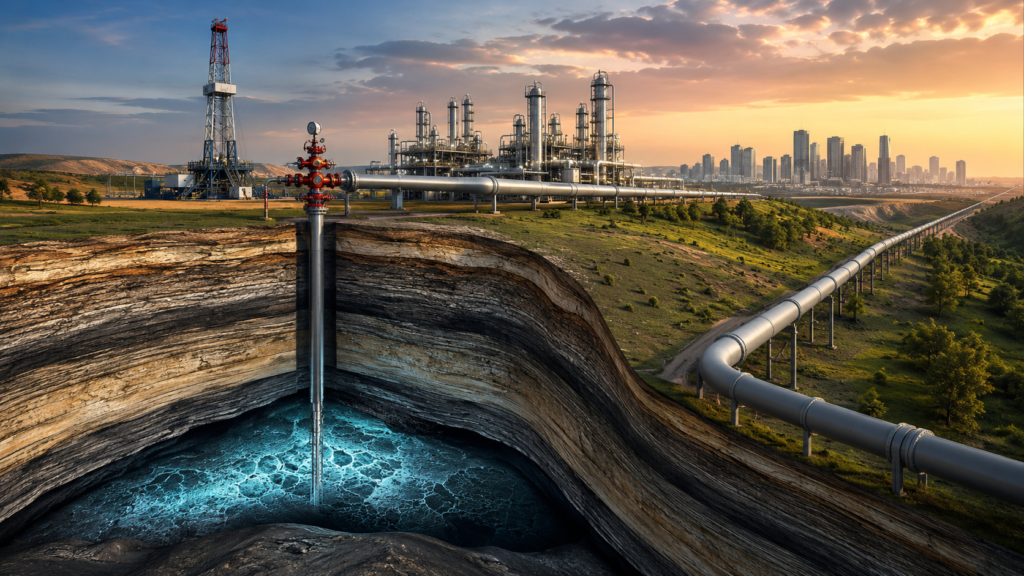
Natural gas is a fossil fuel, meaning it formed from the remains of ancient organic material — primarily marine microorganisms such as algae, zooplankton, and bacteria — that lived hundreds of millions of years ago. When these organisms died, they sank to the ocean floor and were gradually buried under layers of sediment. Over millions of years, heat and pressure from the Earth’s interior began transforming this organic material through a process called catagenesis.
At moderate burial depths and temperatures (roughly 60–150°C), kerogen — the solid organic matter trapped in sedimentary rock — breaks down preferentially into liquid hydrocarbons (crude oil). At greater depths, where temperatures exceed approximately 150°C, the thermal cracking process continues, breaking down heavier molecules into lighter ones. This is the zone known as the “gas window,” where natural gas is predominantly generated.
The two primary organic pathways for natural gas formation are:
- Thermogenic gas — Produced by the thermal decomposition of organic matter buried deep in the Earth. This accounts for the vast majority of commercially extracted natural gas.
- Biogenic gas — Produced at shallow depths by microbial activity (methanogenesis) in environments low in oxygen, such as swamps, marshes, and landfills. This is the same process that produces “marsh gas” and biogas.
Migration and Trapping
Once generated deep underground, natural gas — being less dense than surrounding rock and water — tends to migrate upward through porous rock formations. This migration continues until the gas encounters an impermeable cap rock (such as shale or salt deposits) that prevents further upward movement. The gas accumulates beneath this barrier in a porous reservoir rock, forming a natural gas field or reservoir.
Common geological traps include:
- Anticline traps — Upward arching folds of rock that create a dome beneath which gas collects.
- Fault traps — Displacement of rock layers by faulting creates barriers against which gas accumulates.
- Stratigraphic traps — Changes in rock type or porosity that prevent gas migration.
Conventional vs. Unconventional Gas
Conventional natural gas is found in discrete, porous reservoirs from which it flows relatively easily when a well is drilled. These reservoirs have historically been the primary source of commercial production.
Unconventional natural gas refers to gas found in formations that do not allow it to flow freely, requiring special extraction techniques:
- Shale gas — Trapped within fine-grained shale rock. The development of hydraulic fracturing (“fracking”) and horizontal drilling in the late 20th and early 21st centuries unlocked vast shale gas reserves, fundamentally reshaping global gas markets, particularly in North America.
- Tight gas — Trapped in low-permeability sandstone or limestone formations.
- Coalbed methane (CBM) — Adsorbed onto the surface of coal seams.
- Methane hydrates — Ice-like structures trapping methane molecules in deep-sea sediments and permafrost. These represent an enormous potential future resource, though commercial extraction remains largely undeveloped.
Chemical Composition of Natural Gas
Primary Component: Methane
The dominant component of natural gas is methane (CH₄), a simple hydrocarbon consisting of one carbon atom bonded to four hydrogen atoms. In pipeline-quality natural gas delivered to consumers, methane typically constitutes 70–90% or more of the total volume. It is methane that gives natural gas its primary energy value and combustion characteristics.
When methane burns completely in the presence of oxygen, the reaction produces carbon dioxide and water vapor:
CH₄ + 2O₂ → CO₂ + 2H₂O
This reaction releases approximately 890 kJ/mol of energy and is significantly cleaner than the combustion of coal or heavy oil, which produce larger quantities of particulates, sulfur dioxide, and other pollutants.
Other Hydrocarbon Components
Raw natural gas extracted from the ground contains varying amounts of heavier hydrocarbons alongside methane. These are collectively known as natural gas liquids (NGLs) or wet gas components, and they are typically separated out during processing:
These heavier hydrocarbons are ethane, propane, butane, and pentane, which are valuable in their own right. Ethane is a critical feedstock for ethylene production in the petrochemical industry. Propane and butane are sold as liquefied petroleum gas (LPG), widely used for heating and cooking. Pentane and heavier fractions may be blended into gasoline.
| Component | Chemical Formula | Typical Content in Raw Gas |
|---|---|---|
| Methane | CH₄ | 70–90% |
| Ethane | C₂H₆ | 0–20% |
| Propane | C₃H₈ | 0–8% |
| Butane | C₄H₁₀ | 0–5% |
| Pentane and heavier | C₅H₁₂+ | trace amounts |
Gas with a high proportion of these heavier components is called “wet gas,” while gas that is predominantly methane is called “dry gas.”
Non-Hydrocarbon Components
Raw natural gas also typically contains several non-hydrocarbon gases that must be removed or reduced before the gas enters transmission pipelines:
- Carbon dioxide (CO₂) — Present in varying concentrations (0–8% or more in some fields). CO₂ reduces the heating value of the gas and is corrosive in the presence of water. It is removed during processing.
- Hydrogen sulfide (H₂S) — A toxic, highly corrosive gas with a characteristic “rotten egg” odor. Gas containing significant H₂S is called “sour gas” and requires “sweetening” treatment (typically using amine scrubbers) before it can be safely transported. The sulfur recovered from this process is a commercially valuable byproduct.
- Nitrogen (N₂) — An inert gas that dilutes the heating value of natural gas. It is removed if present in significant amounts.
- Helium (He) — Found in trace amounts in some natural gas fields, particularly in the United States and Qatar. Where concentrations are sufficiently high, helium is extracted as a valuable industrial gas.
- Water vapor (H₂O) — Almost always present in raw natural gas. Water must be removed (dehydration) to prevent corrosion, hydrate formation, and freezing in pipelines.
- Radon and other trace gases — Present in tiny quantities in some formations.
The Odorant: Why Gas “Smells”
Pure methane and the other hydrocarbon components of natural gas are odorless. The distinctive smell that most people associate with natural gas — often described as similar to sulfur or rotten eggs — is not natural but rather deliberately added. Gas companies inject a chemical called mercaptan (methanethiol, CH₃SH) or a similar thiol compound into the gas before distribution. This is a critical safety measure, allowing people to detect dangerous leaks that would otherwise be completely undetectable by smell.
Heating Value
The energy content of natural gas is typically expressed as its heating value, measured in British thermal units (BTU) per cubic foot or megajoules per cubic meter:
- Higher Heating Value (HHV) — Also called gross calorific value; includes the energy released when water vapor in the combustion products condenses to liquid.
- Lower Heating Value (LHV) — Also called net calorific value; excludes the heat of water condensation.
Standard pipeline-quality natural gas in North America has an HHV of approximately 1,020–1,080 BTU per standard cubic foot (SCF), or roughly 37–40 MJ/m³. The exact value depends on the precise composition, particularly the proportion of heavier hydrocarbons present.