Heat Recovery Ventilator: 7 Signs Your Ontario Home Needs One
Table of Contents
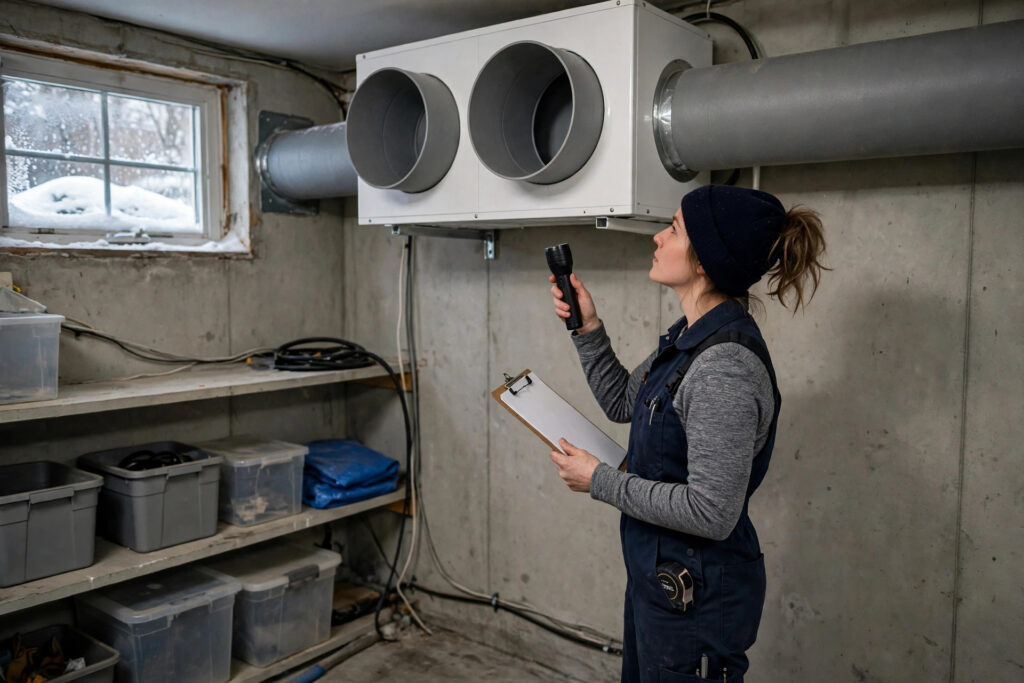
Winter in Ontario means sealed windows, a furnace running for months, and the same indoor air circulating day after day. A heat recovery ventilator is the device that breaks that cycle. It brings fresh outdoor air into your home and exhausts stale indoor air, while recovering most of the heat from the air on its way out. If your home feels stuffy, your windows fog up every morning, or cooking smells linger for hours, a heat recovery ventilator may be the missing piece of your home’s ventilation.
This guide explains what an HRV does, how it works, the seven signs your home needs one, how it differs from an energy recovery ventilator, and what Ontario’s Building Code says about it. It also covers the safe checks you can do yourself and the work that belongs to a licensed technician.
What a heat recovery ventilator does
A heat recovery ventilator is a ventilation device that continuously replaces stale indoor air with fresh outdoor air. Natural Resources Canada describes it as a way to make a home healthier, cleaner and more comfortable, because it clears out pollutants along with the stale air: excess moisture, mould spores, household chemicals and bacteria. Unlike a bathroom fan or a range hood, which only exhaust air, a heat recovery ventilator is balanced. It brings in about as much fresh air as it exhausts, so it does not pull cold air in through cracks or push heated air out through them.
The heat recovery part is what makes it practical in a Canadian winter. The outgoing warm air passes its heat to the incoming cold air before it leaves the house, and in summer the process reverses, stripping some heat from the incoming air. A typical unit recovers roughly 60 to 80 percent or more of the heat in the exhaust air, according to Energy Efficiency Ontario. That is why a heat recovery ventilator can ventilate a house all winter without the heating bill climbing the way it would if you simply opened a window.
How a heat recovery ventilator works
Inside the unit, the two airstreams pass close to each other through a heat exchange core without ever mixing. Heat moves from the warmer stream to the cooler one. The cycle looks like this:
- Stale air is drawn from bathrooms, the kitchen and the laundry room, where moisture and odours are strongest.
- Fresh air is drawn in from outside through a hooded intake on an exterior wall.
- Both streams pass through the core of the heat recovery ventilator. Heat moves from the outgoing stream to the incoming stream, while the air itself stays separate.
- Pre-warmed fresh air is delivered to bedrooms and living areas through the home’s ductwork.
- In very cold weather the unit runs a defrost cycle, briefly warming the core so frost cannot block it. A short defrost pause is normal, not a fault.
Most homes run the unit on low, continuously, and switch it to high for showers, cooking or a house full of guests. The wall control is usually a simple low, high and off switch, sometimes with a timer or a humidity setting. The unit itself has filters on both airstreams, and those filters are the part a homeowner looks after most often.
7 signs your home needs a heat recovery ventilator
Not every home needs one. A draughty older house already gets plenty of fresh air through its gaps, which is part of why it costs so much to heat. A heat recovery ventilator earns its place in a home that is sealed tight enough to trap stale air. These seven signs point that way:
- Condensation on the windows every winter morning. A little fog on a cold morning is normal. Water running down the glass, pooling on the sill, or condensation that never clears by midday means indoor humidity has nowhere to go.
- Bedrooms feel stuffy by morning. If the air in a closed bedroom feels heavy when you wake up, the room has been breathing the same air all night.
- Cooking smells linger for hours. A range hood clears the kitchen, but smells that drift through the whole house and stay there point to weak whole-home ventilation.
- Bathroom humidity hangs around long after a shower. A mirror that stays fogged and towels that never quite dry are signs the moisture is not being exhausted.
- Mould or mildew around windows, sills and bathroom corners. Persistent dampness feeds mould, and mould is a sign the house needs a steady supply of fresh, dry air.
- You open windows in January just to get fresh air. If the only way to freshen the house is to let in minus 10 degree air, the ventilation system is missing, not broken.
- A recent insulation or window upgrade made the house much tighter. Air sealing and new windows cut drafts and heating bills, and they also cut the accidental ventilation the house used to get. A heat recovery ventilator is the usual way to put controlled ventilation back in.
One sign on its own may have another cause. Two or three together, in a home that has been air sealed or rebuilt, is a strong case for a heat recovery ventilator.
Heat recovery ventilator vs energy recovery ventilator
The two devices look alike and do the same basic job, but they handle moisture differently. A heat recovery ventilator transfers heat only. The moisture in the outgoing air leaves with it, which helps dry out a home that runs humid in winter. An energy recovery ventilator, or ERV, transfers heat and some moisture. In winter it returns part of the indoor humidity to the incoming air, and in summer it rejects some of the outdoor humidity before it enters.
- Heat recovery ventilator: transfers heat only. Moisture leaves with the exhaust air. Best fit for Ontario homes that run humid in winter, with condensation on the windows.
- Energy recovery ventilator: transfers heat and some moisture. Returns part of the indoor humidity in winter and rejects some outdoor humidity in summer. Best fit for very tight homes that run dry in winter, or homes with sticky, humid summers.
Neither device is a dehumidifier or a humidifier. An ERV moderates humidity swings; it will not fix a wet basement, and a heat recovery ventilator will not dry out a house that has a moisture source of its own, such as an unvented dryer. For most Ontario homes, an HRV is the usual starting point, and a technician who has measured the home’s humidity can say whether an ERV fits better.
What the Ontario Building Code says about heat recovery ventilators
In Ontario, a heat recovery ventilator is not an optional upgrade on a new build. Since January 1, 2017, the Building Code’s energy efficiency standard, SB-12, has required heat recovery ventilation in new homes. The 2024 Ontario Building Code, in force since January 1, 2025, keeps that requirement in Section 9.32 on ventilation, and the permit package for a new home must include a Mechanical Ventilation Design Summary prepared to CAN/CSA-F326.
The code sets a minimum sensible recovery efficiency of 55 percent at minus 25 degrees Celsius, rising to 65 percent on enhanced efficiency compliance paths. None of this applies retroactively: an existing home is not required to add a heat recovery ventilator. But if you are buying a newly built home, the unit should already be there, and the builder should be able to show you the ventilation design summary that names it.
Safe checks you can do yourself
A heat recovery ventilator needs little attention, but the attention it does need is simple and safe. Work through this list once a season:
- Check the filters. Most units have a filter on each airstream. Pull them out, vacuum or wash them according to the manual, and replace them when they are torn or will not come clean. Check your manual for the schedule; every few months is typical. If you are unsure which filter your system takes, our guide to what MERV rating to choose and how to find your filter size will help.
- Clear the exterior hoods. The intake and exhaust hoods on the outside wall need a clear path. Brush off snow, leaves and ice, and keep shrubs and stored items away from them. A hood buried in snow behaves much like a furnace vent blocked by snow: the system cannot move air, and the house pays for it.
- Check the condensate drain. The unit produces water as it recovers heat. Make sure the drain line is connected, not kinked, and draining freely.
- Confirm the control setting. The wall control should sit on low or continuous, not off, through the heating season. If the unit has been switched off for months, turn it back to low and let it run.
- Listen for the defrost cycle. In a cold snap the unit may pause briefly and sound different while it defrosts the core. That is normal. A unit that stays silent for days, or one that rattles, buzzes or smells of burning, is not.
- Note what changed and when. If a new noise, smell or leak starts, write down when it started and what the unit was doing. A technician will ask.
What not to touch
A heat recovery ventilator is a low-voltage appliance with ductwork, but the work around it is not all homeowner work. Leave these alone:
- Do not open the electrical compartment or rewire the wall control.
- Do not change the ductwork or adjust the balancing dampers. Airflow balance is set at installation, and changing it can starve some rooms and over-ventilate others.
- Do not block, cap or move the intake or exhaust hoods.
- Do not disconnect the condensate drain or the defrost control.
- Do not touch anything that connects the unit to a gas furnace. Gas work in Ontario must be done by a TSSA-licensed technician, and electrical work by a licensed electrician.
When to call a licensed technician
A heat recovery ventilator that stops moving air, leaks water, or starts making new noises needs a professional look. Call a licensed technician if:
- The unit runs but no air moves at the supply grilles.
- Water is leaking from the unit, the drain or the ductwork.
- Ice is building up inside the unit or on the core.
- There is a burning smell, a loud buzz, or a breaker that keeps tripping.
- Condensation and stuffiness do not improve after the filters and hoods are checked.
- You are buying, building or renovating and need the ventilation system sized and balanced for the house.
A heat recovery ventilator is a quiet piece of equipment that does a simple job: it keeps the air in a sealed home fresh without throwing the heat away. If your windows fog every morning and the air feels stale by bedtime, check the filters and the hoods first. If the signs point to a missing system rather than a dirty filter, a licensed technician can size one for the house and install it properly. More guides like this one are on our tools page, and replacement filters and parts are listed in the marketplace.
If the job needs a pro, hire a TSSA-licensed technician and ask to see their licence before any gas work starts.
The Quality HVAC is an information and marketplace platform. We do not install, service, or repair HVAC equipment. Content here is educational only and is not a substitute for a licensed technician. In Ontario, gas appliance work must be performed by a TSSA-licensed technician. If you smell gas or your carbon monoxide alarm sounds, leave the home and call 911 or your gas utility emergency line.