Indoor Air Quality Cognition: What a New PM2.5 Study Means for Toronto Homes
Table of Contents
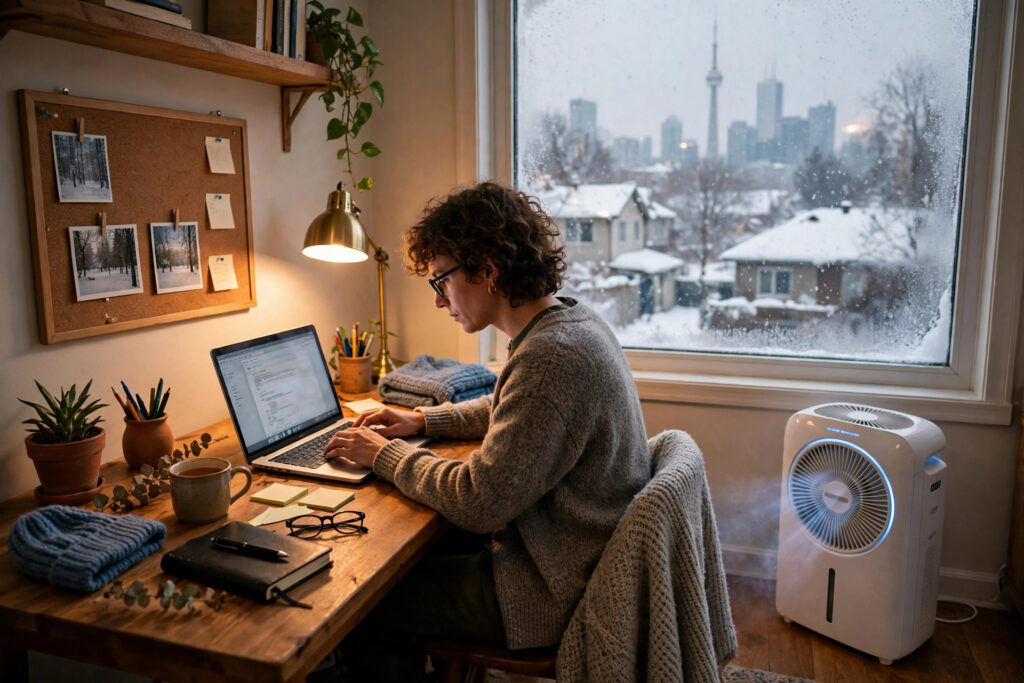
New research on indoor air quality cognition gives Toronto homeowners a fresh reason to pay attention to the air inside a closed-up winter home. A University College London chamber study, reported on October 22, 2026, found that short-term exposure to higher indoor fine particulate matter (PM2.5) was linked to poorer attention and memory in adults, even when other indoor conditions were held steady.
PM2.5 means particles 2.5 micrometres or smaller, from cooking, candles, fireplaces, smoking, and outdoor air coming inside. The study does not prove that a stuffy room makes anyone ill, or that buying a particular device improves thinking. Under tight laboratory control, breathing more PM2.5 for about 90 minutes changed how participants performed on memory and attention tests.
What indoor air quality cognition researchers actually tested
The study was a randomized, single-blind crossover trial in an environmentally controlled chamber at University College London. Ninety working-age adults each completed cognitive tests under two indoor air conditions, one week apart. In the higher-exposure session, unscented paraffin candles burned to generate PM2.5 while a portable purifier ran with a sham filter. In the lower-exposure session, the same setup ran with a HEPA filter.
The contrast was large: about 31.2 micrograms per cubic metre in the higher-exposure condition, compared with about 1.7 in the filtered condition. Temperature, humidity, ventilation rate and volatile organic compounds were held constant, and a small carbon dioxide difference did not change the findings.
Participants took a computer-based test battery covering memory, attention, perception, coordination and reasoning. The overall score fell by an average of 66 points on a 0 to 800 scale in the higher-exposure condition, a moderate effect. Memory and attention showed the clearest differences, including slower reaction times and lower accuracy on selected tasks. Perception results were mixed, with no statistically significant differences in coordination or reasoning.
The study also measured heart rate variability, linked to the autonomic nervous system. Higher PM2.5 exposure was associated with lower heart rate variability during cognitive testing, but not during rest. The paper highlights that executive-skill effects were partly mediated through cardiovagal responses, pointing to a possible heart-brain pathway rather than proving a single cause.
What the study could not prove
The limits matter as much as the headline. Participants were a young, highly educated group, so results cannot simply be generalized to children, older adults, or people with health conditions. The particles came from candle combustion only, with no detailed chemical analysis. The study did not measure job performance, productivity, driving safety, or clinical impairment, so none of those outcomes can be claimed from it alone.
Why indoor air quality cognition matters in a Toronto winter
Toronto heating season is exactly when this research feels close to home. Windows stay closed, cooking and candles happen indoors, fireplaces run, and traffic and wood-smoke particles can still find their way inside. The study’s higher level, about 31.2 micrograms per cubic metre, was close to the global average of 31.3 cited from the State of Global Air 2024. That does not mean every Toronto home sits at that level, but the experiment was not testing an extreme dose.
For context, the World Health Organization guideline values cited in coverage are 5 micrograms per cubic metre as an annual average and 15 over 24 hours. Those are health guidelines, not a Toronto building code. For indoor air quality cognition, the narrower takeaway is that short-term particle levels are worth noticing in rooms where people concentrate for long stretches.
This finding differs from our earlier performance based ventilation post, which explained how engineers design commercial ventilation using the Indoor Air Quality Procedure in ASHRAE Standard 62.1. This study is about a single 90-minute exposure in an occupied room.
Indoor air quality cognition: what Toronto homeowners can check first
- Cut sources first. Run a kitchen range hood vented outdoors while cooking, limit candles and open flames indoors, and do not smoke indoors.
- Keep air moving sensibly. Do not close supply vents or dampers as a quick fix. Chronic stuffiness is a ventilation question for a qualified design professional, as in our performance based ventilation guide.
- Check filtration you already have. Look at your furnace filter, keep return vents unblocked, and follow the manufacturer’s instructions. This is basic maintenance, not a medical claim.
- Understand the HEPA condition. The cleaner room used a HEPA purifier to create the low-exposure condition. It does not prove any home purifier will lift test scores. If you already own one, running it where you work or study is the closest home parallel to the experiment. That distinction is central to indoor air quality cognition: the experiment isolated particles, not a product.
- Keep safety work licensed. Any gas or electrical work is licensed-professional-only. If a carbon monoxide alarm sounds, or you smell gas, follow the alarm and utility instructions and get licensed help.
Indoor air quality cognition is still a young research area. One chamber study should not rewrite how you run your home. It does give a concrete reason to treat cooking smoke, candle smoke and stale winter air as more than a comfort issue.
Explore our performance based ventilation guide next, and see our residential and commercial-industrial guides, or visit our contact page for more reading.
Sources: Zhou, Huebner, Liu and Ucci, “Short-term indoor fine particulate matter exposure impedes cognitive performance and autonomic nervous system in adults,” iScience 29, 117904 (2026); Contracting Business, “Study Links Indoor Air Pollution to Changes in Cognitive Performance” (October 22, 2026); ScienMag summary of the study (October 17, 2026).



One Comment