How to Find an HVAC Contractor: 7 Checks Before You Hire
Learning how to find an HVAC contractor you can trust is worth an hour of your time before you hand anyone your furnace room key. The wrong hire can cost you twice: once for the bad job, and again for the contractor who fixes it. The right one gives you a written scope, a fair price, and work that passes inspection. Here is how to vet one, step by step.
If you are still deciding whether you even need a contractor, start with the symptom library, which explains what common noises, smells, and error codes mean in plain language. And while you are at it, the free tools can help you check your filter size and furnace details before anyone quotes on a replacement.
How to find an HVAC contractor for your exact job
Start by naming the job precisely, because different HVAC work needs different licences. A gas furnace, boiler, or water heater needs gas qualifications. A heat pump or air conditioner needs refrigeration qualifications. Panel or wiring work needs an electrical licence. One company may cover several trades, but check each licence separately instead of assuming one badge covers everything.
Ask every candidate the same opening question: “What licence covers this work, and can I see the number?” A good contractor answers it straight away. A vague answer is your first warning sign.
Check the licence before you check the price
This is the step most homeowners skip, and it matters more than the quote.
For any gas work in Ontario, the company must be a TSSA-registered fuels contractor, and the technician doing the work must hold the right gas certificate. TSSA publishes a searchable list of registered fuels contractors, updated monthly, so you can confirm a company yourself before anyone touches your furnace or water heater.
For electrical work, Ontario law requires a Licensed Electrical Contractor. Ask for the 7-digit ECRA/ESA licence number and look it up on the Electrical Safety Authority’s contractor finder before work starts. The licensed contractor files the ESA notification for the job, and when the work is done you should receive an ESA Certificate of Acceptance. Keep that certificate: your insurance company may ask for it, and it matters at resale time.
For refrigeration and air conditioning work, ask whether the technician holds a Certificate of Qualification in the trade. Verify every number before work starts, not after. A licence number printed on a van or a quote means nothing until you have looked it up yourself.
Get three written quotes, and compare scope, not just price
Give all three contractors the same description of the job, then compare what comes back in writing. A useful quote names the equipment make and model, the labour, the permits, the warranty terms, and the timeline. A quote that only gives a single total tells you almost nothing.
The cheapest quote with a vague scope is usually the expensive one in the end, because the extras show up later as change orders. Watch for quotes that never name the equipment, “allowances” that can balloon, and warranty terms that are missing entirely. If two quotes are far apart, the difference is almost always in the scope, so ask both contractors to explain it line by line.
Ask for insurance, WSIB, and a real reference
Ask for proof of liability insurance and a WSIB clearance letter. If a worker is hurt on your property and the company has no coverage, the problem can land on you, so this is not paperwork for its own sake.
Then ask for one past customer you can actually call, and make the call. Ask whether the crew showed up on time, whether the price held, and whether anything went wrong and how it was handled. Online reviews help too, but read them for patterns across many reviews, not for one angry or one glowing outlier.
Red flags that mean walk away
Walk away from any contractor who:
- Offers a cash-only price with no receipt.
- Cannot give you a licence number, or says it is “being renewed.”
- Pressures you to sign today for a “today only” price.
- Wants full payment before the work starts.
- Asks you to pull the permit yourself, or says no permit or notification is needed.
- Will not put the scope and price in writing.
- Knocks on your door after a storm or a cold snap with a same-day deal.
Any one of these is enough to move on to the next quote. Good contractors do not need these tactics.
Before you sign anything
A proper contract states the scope, the equipment, the total price, a payment schedule tied to milestones, start and finish dates, and the warranty terms for parts and labour, including who honours them. Read the warranty section twice: a long equipment warranty means little if nobody will come back to fix it.
Two more checks before you sign. First, some Ontario rebate programs require pre-approval before installation, so check the program rules before the work starts, not after. Second, keep copies of everything when the job is done: the contract, any permits or certificates, the equipment manuals, and the warranty papers. You will want them at resale time, and you will want them if anything fails in year two.
When to stop and call a pro right away
Most hiring decisions can wait for three quotes. These cannot:
- If you smell gas, leave the house, do not flip switches, and call your gas utility or emergency services from outside.
- If your carbon monoxide detector is going off, leave immediately and call 911 or fire services from outside. Do not go back in to investigate.
- If your furnace is flashing error codes, note the blink pattern and stop resetting it over and over. The code is the furnace telling you why it stopped.
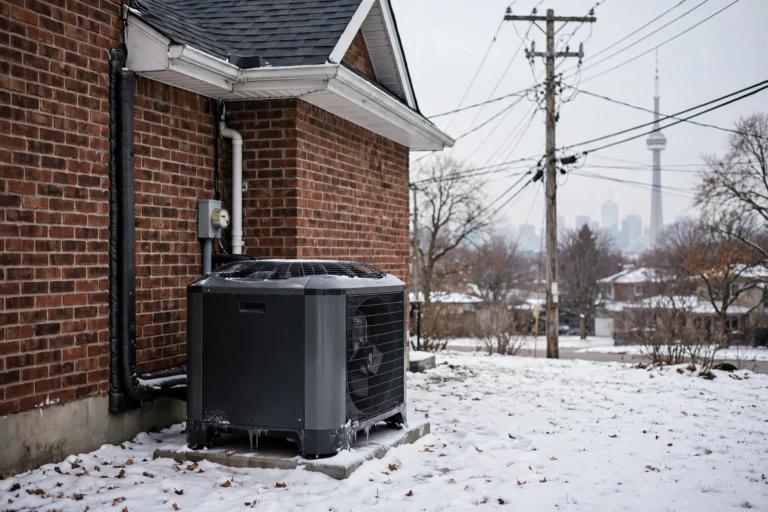
- If your heat pump is iced solid well outside its normal defrost cycles, that is a real problem, not winter weather.
For the cases that can wait, take your time, check the licence, compare written quotes, and hire the contractor whose paperwork is as solid as their pitch.
This article is general information for Ontario homeowners, not professional advice. Gas and electrical work in Ontario must be done by properly licensed or registered contractors, so when in doubt, check the licence first.