
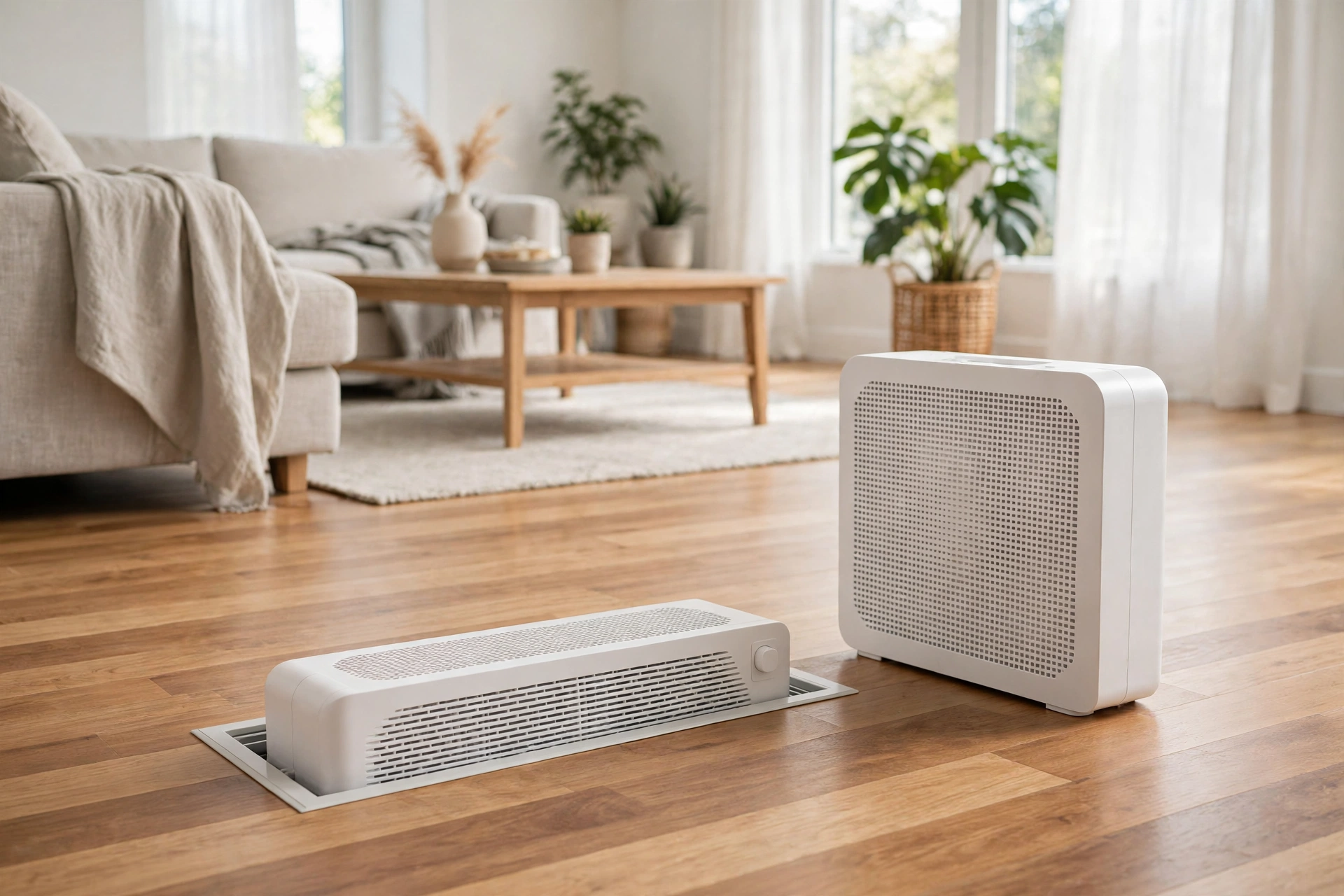
Register Booster Fans Compared: AC Infinity AIRTAP T4 vs VEVOR vs the Generic Ones
Table of Contents
One room is always a few degrees behind the rest of the house, even when the furnace is running fine. A register booster fan sits in that room’s floor or wall register and pulls a little more heated or cooled air through it. This register booster fan comparison looks at three very different options — the AC Infinity AIRTAP T4, the VEVOR Register Booster Fan, and the generic thermostat models sold under many names — so you can judge them on airflow, noise, controls, build and price, not on the loudest listing.
Start with an honest point: none of these fans fixes a crushed, disconnected or undersized duct. The duct decides how much air arrives at the register in the first place. A booster fan can only move the air that is already getting there a little faster. If the duct is the problem, the fan will be a disappointment, however much it costs.
When a Booster Fan Helps — and When It Will Not
A booster fan is worth considering when the problem is limited to one room. It can help when:
- One room lags behind while the rest of the house is comfortable.
- The room is at the end of a long duct run, so less air reaches it.
- The room sits over a garage or above an unheated space and cools faster than the rooms around it.
- You want a small boost in the heating or cooling season without changing the furnace settings.
A booster fan will not help when the cause is elsewhere in the system. A blocked return, a closed damper, a dirty furnace filter or a furnace airflow problem will still limit the air, no matter how hard the register fan runs. If several rooms are uneven, read our guide to uneven heating in a Toronto home first, and check the symptoms hub for what each sign usually means.
Register Booster Fan Comparison: The Three Options at a Glance
All three fans below are the 4-by-10-inch size, the most common register size in Ontario homes. This register booster fan comparison is based on manufacturer and listing specifications, with prices re-checked on November 21, 2026.
| Feature | AC Infinity AIRTAP T4 (4×10) | VEVOR Register Booster Fan (4×10) | Generic thermostat models |
|---|---|---|---|
| Airflow | 130 CFM | 100 CFM | Commonly quoted 80–200 CFM* |
| Noise | 17 dBA | 18 dB or less | Varies; rarely stated clearly |
| Speeds | 10 | 10 | Varies by model |
| Controls | Heating and cooling temperature triggers; onboard controls plus Bluetooth app | Thermostat LCD panel plus remote (26 ft range) | Onboard or remote controls |
| Power | 6 W, plug-in | 6 W DC, 12 ft cord | Varies by model |
| Frame | CNC-machined anodized aluminium | Aluminium | Plastic or thin aluminium |
| Warranty | 2 years | 1 year manufacturer’s parts and labour (Best Buy Canada listing) | Effectively no local warranty |
| Price checked November 21, 2026 | US$59.99 manufacturer MSRP; CAD price on Amazon.ca not verified today | $59.90 CAD at Best Buy Canada (white, VEVOR Official Store CA; sale ends November 29, 2026) | About CAD 30–55 retail |
* Generic airflow figures are seller claims and vary widely between listings for what may be the same fan. Treat them with caution and compare the other features — controls, noise and build — instead of chasing the biggest CFM number.
Facts checked: manufacturer and listing specifications were checked on October 23, 2026. Prices were re-checked on November 21, 2026: the VEVOR 4-by-10-inch model BT-DF0410RCA (white) was $59.90 CAD at Best Buy Canada, sold and shipped by VEVOR Official Store CA. The AC Infinity AIRTAP T4 CAD price on Amazon.ca was not verified today, so only the manufacturer’s US$59.99 MSRP is given for it — see the AC Infinity AIRTAP T4 page for the manufacturer’s specifications. Generic models were about CAD 30–55 retail.
What the Numbers Mean in a Real Room
The AIRTAP T4’s 130 CFM is the highest airflow figure here, against the VEVOR’s 100 CFM, but airflow alone does not settle it. Both fans offer 10 speeds, and both are quiet on paper — 17 dBA for the AIRTAP T4 and 18 dB or less for the VEVOR.
In a bedroom, that small noise difference matters more than it does in a living room, because the fan runs while you sleep. The real difference is control: the AIRTAP T4 uses heating and cooling temperature triggers, with onboard controls and a Bluetooth app, while the VEVOR uses a thermostat LCD panel and a remote with a 26-foot range. The VEVOR’s 12-foot cord also gives you more reach to an outlet than a short-cord fan.
Build is the other split. The AIRTAP T4 has a CNC-machined anodized aluminium frame and a 2-year warranty. The VEVOR has an aluminium frame and a 1-year manufacturer’s warranty on the Best Buy Canada listing. Generic models are usually plastic or thin aluminium, with effectively no local warranty — if one fails, there is often no one to call.
Register Booster Fan Comparison: Who Should Buy Which?
In short, this register booster fan comparison comes down to where the fan will run and how much quiet and control are worth to you.
AC Infinity AIRTAP T4 — the quiet, controlled choice
Choose the AC Infinity AIRTAP T4 for a bedroom or nursery, where the 17 dBA rating and app scheduling matter most, and where the 2-year warranty is worth paying for. It is the quietest, best-controlled fan in this comparison, and the aluminium frame should last.
VEVOR — the value pick on paper
Choose the VEVOR as the value pick on paper. At $59.90 CAD on November 21, 2026, it gives you 100 CFM, 10 speeds, a thermostat panel and a remote for about the same money as the AIRTAP T4’s US$59.99 MSRP — before any currency conversion or shipping. Its longer cord and remote are genuinely useful in a hard-to-reach register.
Generic models — the cheapest test
Choose a generic thermostat model only as the cheapest test of whether boosting helps at all. At about CAD 30–55, it is the lowest-risk way to find out if more air at one register fixes the room. If it does, you can then decide whether a quieter, better-built fan is worth it. If it does not, you have learned that the problem is the duct or the system, not the register.
Before You Buy: Measure, Check Power and Change the Filter
- Measure your register before you order. Sizes such as 4-by-10, 4-by-12 and 6-by-10 inches look alike at a glance, and a fan that does not fit will not seal or sit flat.
- Check for an outlet within cord reach. The VEVOR’s cord is 12 feet long, but not every register has an outlet nearby, and an extension cord across a floor is not a good plan.
- Change the furnace filter first. A dirty filter starves every room, and a fresh filter costs far less than a fan. The tools hub can help you find the right filter size.
Finally, skip all three fans if two or more rooms are cold. That is a ductwork or furnace problem, not a problem with one register, and no booster fan will fix it. A licensed technician should look at the ductwork and the furnace airflow instead. You can browse equipment in the marketplace if you are comparing parts, but a system-wide heating problem needs a professional diagnosis, not a register accessory.
If the job needs a pro, hire a TSSA-licensed technician and ask to see their licence before any gas work starts.
The Quality HVAC is an information and marketplace platform. We do not install, service, or repair HVAC equipment. Content here is educational only and is not a substitute for a licensed technician. In Ontario, gas appliance work must be performed by a TSSA-licensed technician. If you smell gas or your carbon monoxide alarm sounds, leave the home and call 911 or your gas utility emergency line.