Saskatchewan CO Alarm Law: 5 Critical Facts Before Henry’s Law Starts Nov 1
Saskatchewan’s new CO alarm law takes effect on November 1, 2026, and building owners now have only days left to comply. Under the Saskatchewan CO alarm law known as Henry’s Law, every residential suite in a multi-unit building, including apartments, condos and houses with secondary suites, must have its own carbon monoxide alarm, no matter where the suite sits in the building or how old the building is.
What happened with the Saskatchewan CO alarm law
On October 27, 2026, TheRegional reported that Saskatchewan building owners have just over a week to get ready. Melville fire chief Aaron Buckingham told the outlet that the change closes a gap in provincial safety rules, and he urged every household with gas appliances to take CO alarms seriously.
The rule was first announced by the Government of Saskatchewan on May 5, 2026, as an amendment to the National Building Code for the province. It is named after Henry Losco, an 11-year-old who died of carbon monoxide poisoning in Regina in December 2025 after a boiler malfunction in a multi-unit residential building released CO into the building.
Source: TheRegional, and the Government of Saskatchewan’s CO alarm page.
Key details of Henry’s Law
Here is what the Saskatchewan CO alarm law requires, based on the province’s own advisories.
- Deadline: owners of all new and existing multi-unit residential buildings must comply by November 1, 2026, when The Building Code (Henry Losco) Amendment Regulations, 2026 come into force.
- Every suite: each suite must have at least one CO alarm inside it. Before, alarms were mainly required in suites that shared a wall, floor or ceiling with a parking garage or service room, which the province decided did not protect all residents.
- Placement: the provincial advisory says alarms go inside each sleeping room or within five metres (16 feet) of each sleeping room door, and inside each service room with a fuel-burning appliance.
- Owner duty: the building owner, or the owner of each suite, must install, maintain and test the alarms.
- Detector option: a ministerial interpretation effective September 21, 2026 lets buildings with fire alarm systems use interconnected CO detectors that meet CAN/ULC 588 instead of standalone CO alarms.
Why it matters for Ontario homeowners and gas technicians
The Saskatchewan CO alarm law is a provincial rule, so it does not change what Ontario requires. But the story behind it is a familiar one for anyone working on gas equipment. A single faulty boiler or poorly vented appliance in a shared building can push carbon monoxide into suites that nobody thought were at risk. That is exactly why the province widened its rule from “suites near the boiler room” to “every suite.”
Ontario already requires CO alarms in homes with a fuel-burning appliance or an attached garage, and in multi-unit buildings the rules focus on suites near service rooms and garages. Saskatchewan’s move is a strong reminder that landlords and condo boards here can choose to go further than the minimum, especially in older buildings with central boilers.
For G3 and G2 students, this is a real-world lesson in why venting, combustion air and appliance maintenance matter. Spillage, a cracked heat exchanger or a blocked flue can all produce CO, and a technician’s inspection is often the first line of defence. Our G3 gas technician glossary explains the key combustion and venting terms, and our guide on what to do when a carbon monoxide detector goes off covers the first steps at home.
What to do next
You do not need to live in Saskatchewan to learn from the Saskatchewan CO alarm law. These steps protect any home with gas appliances.
- Test every CO alarm in your home this week and check the date on the back. Chief Buckingham notes the accepted practice is to replace alarms at least every 10 years.
- Buy alarms that carry a CSA or ULC certification mark, and avoid uncertified devices from unknown online sellers.
- Put an alarm near your mechanical room if you have a gas furnace, water heater or boiler.
- Book a yearly furnace or boiler inspection with a licensed gas technician before the cold weather sets in.
- If an alarm sounds, get everyone outside right away and call 911. Do not stay inside to find the cause.
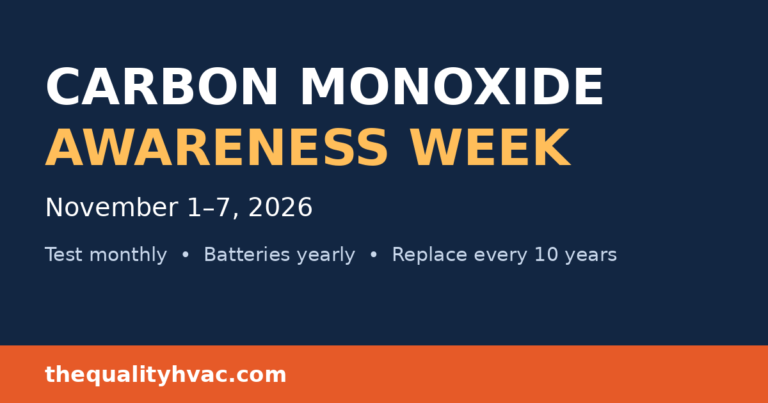
Carbon Monoxide Awareness Week runs November 1 to 7, the same day Henry’s Law begins. Our CO alarm checklist for Ontario is a good place to start.
FAQ
Does the Saskatchewan CO alarm law apply in Ontario?
No. Henry’s Law only applies in Saskatchewan. Ontario has its own CO alarm rules under the Ontario Fire Code.
When does the Saskatchewan CO alarm law take effect?
November 1, 2026. It applies to all multi-unit residential buildings in Saskatchewan, new or existing.
Who pays for and installs the alarms?
The building owner, or the owner of each suite, is responsible for installing, maintaining and testing the required alarms.
How long does a CO alarm last?
Most alarms should be replaced at least every 10 years. Always check the manufacturer’s date and instructions.