Daikin’s R32 Retrofit Gives Old VRF Systems a Lower-GWP Future Without New Piping
Daikin’s new R32 retrofit gives owners of ageing R-410A VRF systems a third option: keep the pipes, change the refrigerant. Announced by Daikin Europe on November 13, 2026, and reported by pv magazine on November 23, the Mini VRV 5 S-series replacement technology upgrades an existing R-410A VRV/VRF system to R-32 equipment while reusing suitable existing refrigerant piping and wiring. For Toronto’s small commercial buildings, offices, clinics and multi-residential properties, that matters: replacing hidden pipework is usually the most disruptive and expensive part of the job.
Table of Contents
What the R32 retrofit changes
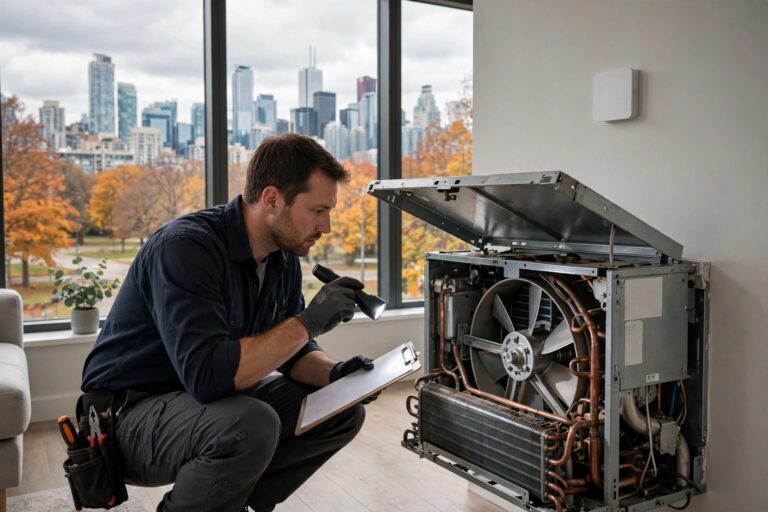
The new range is the Mini VRV 5 Heat Pump RXYSA-B, offered in 4, 5 and 6 HP sizes. The indoor and outdoor units are replaced, while the existing branch piping, remote-control wiring, indoor-outdoor wiring and drainpipes are kept where suitable, and existing controllers can be evaluated for reuse. That is the whole point: in a VRF changeover, the pipework buried in ceilings and walls is usually the costliest and most disruptive part to replace.
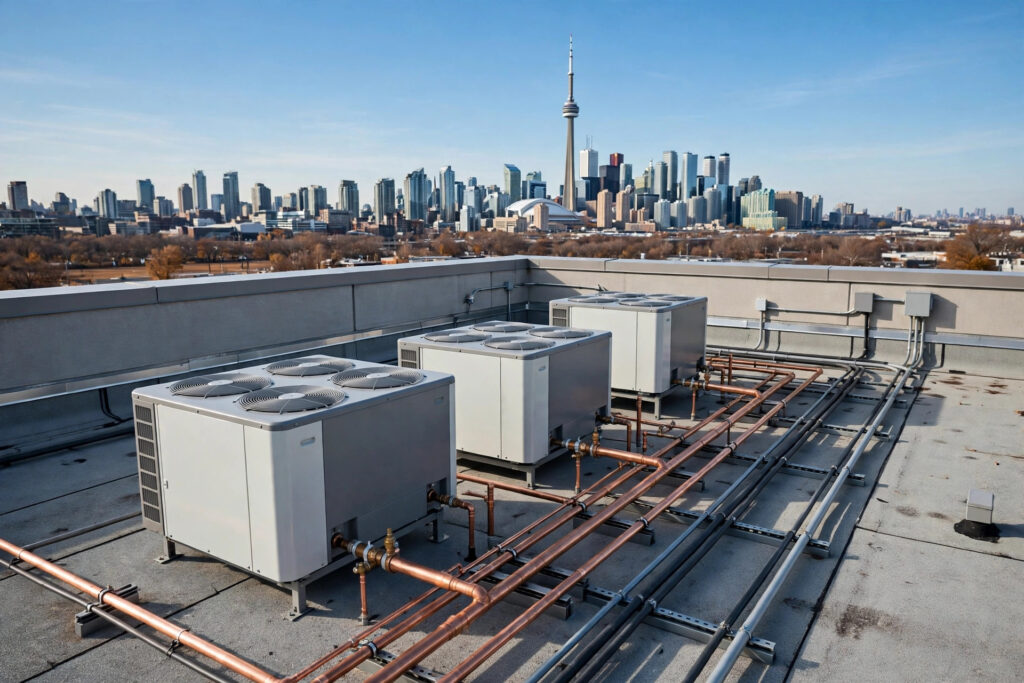
Daikin’s headline numbers: installation time down by up to 22% and capital expenditure down by up to 55% compared with a complete system replacement, and energy consumption down by up to 16% compared with an equivalent R-410A system. Treat those as the manufacturer’s claims: they have not been independently verified, and Daikin has not yet published full RXYSA-B specifications. The figures quoted so far belong to the existing RXYSA-A models: nominal cooling 12.1 to 15.5 kW, rated heating 8.4 to 10.7 kW, maximum heating up to 18 kW. The outdoor unit is compact and single-fan, 869 mm tall, as low as 39 dB(A), with piping up to 300 metres.
The climate case is straightforward. R-32 has a global warming potential (GWP) of 675, about 68% lower than R-410A at 2,088. Every kilogram that eventually escapes warms the atmosphere far less, and that is why the industry is moving off R-410A.
Why R-410A systems need a way forward
Canada is phasing down hydrofluorocarbons under the Ozone-depleting Substances and Halocarbon Alternatives Regulations, which carry out the Kigali Amendment. Allowable HFC consumption falls in steps: 10% below baseline in 2019, 40% in 2024, 70% in 2029 and 85% from 2036. New equipment now ships with R-32 or R-454B instead.
That does not make an existing R-410A system illegal: it can keep running and be serviced. But the direction is one-way: every manufacturer is redesigning around lower-GWP refrigerants. A retrofit path matters because most R-410A VRF systems in Toronto buildings still have years of life left in their pipework, even as their outdoor units age out. An R32 retrofit lets the building keep that pipework and move to the refrigerant the market is standardising on.
The safety piece: built-in leak detection
R-32 is classified A2L, mildly flammable with a low burning velocity; R-410A is A1 and non-flammable. That is the trade-off for the lower climate impact, and it is why the new range carries Daikin’s Shirudo safety technology: integrated refrigerant leak detection sensors, audible and visual alarms, and automatic shut-off valves to limit a leak. Daikin says the factory-fitted measures support compliance with IEC 60335-2-40, the safety standard for flammable refrigerants in occupied spaces. Refrigerant work is licensed-professional work: sizing, charge limits and leak mitigation must be handled by a qualified contractor, not improvised on site.
What Toronto building owners should do about the R32 retrofit
If your building runs a VRF or VRV system, here is the sequence:
- Find out what you have: the outdoor unit model and install date, and whether it is a Daikin Mini VRV 5 S-series or another R-410A VRF system.
- Ask a licensed HVAC contractor to survey the existing piping and wiring. Reuse is only where suitable, and only a survey can say whether your lines qualify.
- Ask about leak detection and charge limits for each occupied space the system serves.
- Get timing in writing. Daikin has not published an availability date or full specifications for the RXYSA-B models, and the announcement came from Daikin Europe, so confirm Canadian availability with a local representative before planning a project around it.
- Do not rush a working system. An R-410A system that is running well can keep running; this R32 retrofit is an option for replacement time, not an emergency.
Ontario rebate programs are written mostly for residential whole-home heat pumps, so check the current terms before assuming a commercial VRF job qualifies. Our rebates hub tracks the programs that are live now.
What is still unknown
Three gaps to watch. There is no availability date, no confirmed RXYSA-B specifications, and no independent verification of the 22%, 55% and 16% claims. Even so, it is good news for owners of R-410A VRF systems: manufacturers are building a cheaper bridge to lower-GWP refrigerants instead of leaving every old system stranded. We will update this post when Daikin confirms Canadian availability and full specifications.
If replacement is on the horizon for your building’s VRF system, a licensed HVAC contractor can survey the existing piping and confirm whether a retrofit path like this fits. Browse our commercial and industrial services, or get in touch through our contact page.
Sources: pv magazine, November 23, 2026 – https://www.pv-magazine.com/2026/11/23/daikin-launches-r32-retrofit-solution-for-existing-residential-heat-pump-series/ ; refindustry, November 23, 2026 – https://refindustry.com/news/daikin-introduces-mini-vrv-5-replacement-technology-for-r-410a-systems/ ; Daikin Europe press release, November 13, 2026 – https://www.polyfact.com/sources/5c0c6639-7b68-48f4-a278-e5dfa5582994 ; HVAC Engineering Canada, refrigerant regulations guide – https://www.hvacengineering.ca/guides/refrigerant-regulations-and-low-gwp-options-in-canada/ ; Ask HVAC Canada, refrigerant phase-out guide – https://askhvac.ca/resources/blog/refrigerant-phase-out-in-canada