The Garage Air Nobody Could Breathe: A Toronto Condo Parking Fix
The Garage Air Nobody Could Breathe: A Toronto Condo Parking Fix
The complaints started the way these problems usually do. Residents in a North York condo said the underground garage smelled like exhaust by 8 a.m., headaches were common on the walk to the elevator, and one level always felt heavy and stale. The exhaust fans looked fine from the ground. What had actually failed was the parking garage ventilation system that was supposed to run them.
Underground garages collect carbon monoxide and other vehicle exhaust every time cars start, idle, and queue for the ramp. Good parking garage ventilation removes that air before it builds up, brings in replacement air, and proves it is working with sensors that someone actually tests. When any part of that chain fails quietly, the garage can look normal while the air gets worse by the hour.
Table of Contents
How Parking Garage Ventilation Is Supposed to Work
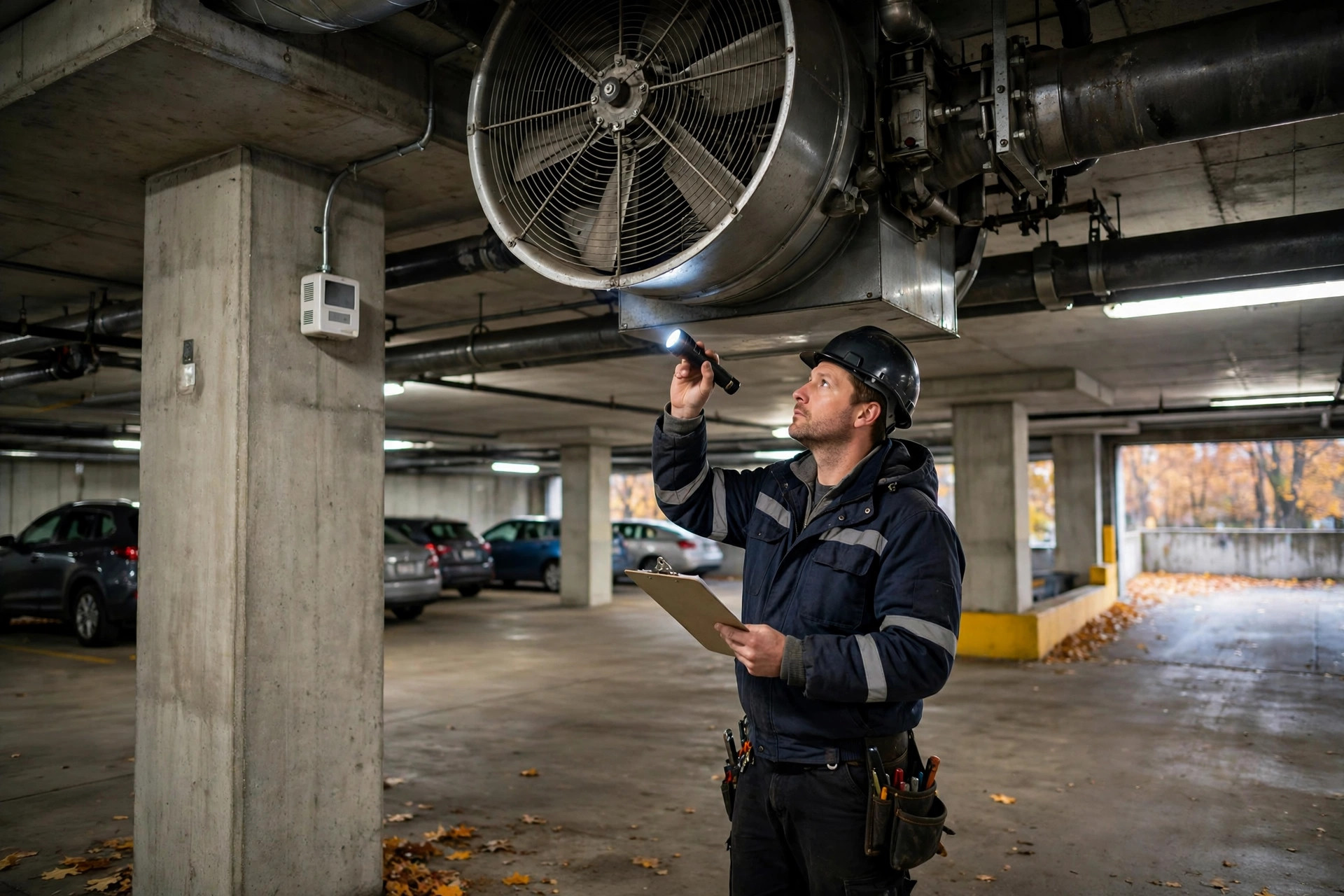
A typical Toronto condo or commercial garage is a system, not a single fan:
- Exhaust fans pull contaminated air out of the garage, usually near the ceiling and the drive aisles where exhaust collects.
- Carbon monoxide sensors mounted on pillars and walls tell the fans when to start, speed up, or slow down.
- Makeup air openings and dampers let fresh outside air in to replace what the fans remove, so the garage does not pull air down stairwells and elevator shafts instead.
- Controls and alarms stage the fans, warn the building operator when levels stay high, and record faults when a fan or sensor fails.
When the system is working, most residents never think about it. Fans ramp up during the morning and evening rush, settle back when the garage is quiet, and the air on every level stays clear. Problems begin when the system keeps the appearance of working while one link in that chain has stopped doing its job.
The Failures a Parking Garage Ventilation Inspection Actually Finds
In the North York case, and in many Toronto garages like it, the inspection found a familiar pattern. Two CO sensors had drifted out of calibration and were reading low, so the controls believed the air was cleaner than it was. One exhaust fan had a worn belt and was moving far less air than its motor suggested. A makeup air damper was stuck partly closed after a summer repair, starving the system of replacement air.
None of those faults is dramatic on its own. Together they meant the fans ran late, moved too little air, and pulled what air they could from the lobby and stairwell doors. That is why residents noticed exhaust smells inside the building, not just in the garage. A proper parking garage ventilation inspection tests each part against the others, instead of simply confirming that a fan spins.
Warning Signs Your Parking Garage Ventilation Needs Attention
- Exhaust smells reach the lobby, stairwells, or elevator at ground level
- The garage air feels stale or heavy during the morning and evening rush
- Fans either run at full speed all day or almost never seem to run at all
- Residents report headaches or irritation after short walks through the garage
- Condensation, soot staining, or rust is building up on ducts, dampers, and doors
- CO alarms or building-automation faults are being cleared without a written follow-up
- Garage doors and pedestrian doors are unusually hard to pull open, a sign of pressure imbalance
Any one of these is a reason to book an inspection. Several together mean the system is no longer controlling exhaust the way it was designed to, and the fix should not wait for the next annual review.
What a Licensed Technician Checks, Step by Step
- Sensor testing and calibration. Each CO sensor is tested with calibration gas and replaced or recalibrated if its reading has drifted. A sensor that has never been tested is an assumption, not a safety device.
- Fan performance. Belts, bearings, motor draw, and actual airflow are checked, because a running motor does not guarantee a fan is moving its rated air.
- Dampers and makeup air. Dampers are cycled open and closed, and makeup air paths are confirmed clear, so exhaust air can actually leave and fresh air can enter.
- Controls and alarms. Fan staging, high-level alarms, and fault reporting to the building system are triggered on purpose to prove they work before a real event does it.
- A rush-hour recheck. Readings are taken again while cars are moving, which is the only test that reflects the conditions residents complained about.
Electrical repairs, gas-fired makeup air unit work, and control wiring in Ontario are licensed-professional-only work. A building operator can log complaints, watch for alarms, and keep access clear, but the testing and repair belong to qualified technicians. If your garage includes gas-fired equipment, verify the contractor through TSSA’s fuels contractor lookup before work starts.
Parking Garage Ventilation and Energy: Why Sensors Save Money Too
Garage fans are some of the largest motors in a condo or commercial building. Running them at full speed around the clock wastes a great deal of electricity and heated makeup air in winter. Demand-controlled ventilation, where tested sensors stage the fans to match actual vehicle activity, is the standard fix: the fans work hardest during the rush, ease off overnight, and still respond immediately when CO rises.
The catch is that the savings depend entirely on sensor accuracy. A demand-controlled system with drifted sensors saves money by under-ventilating, which is the North York failure in a different costume. Calibration is not paperwork. It is what makes both the safety case and the energy case true. Similar logic applies above grade, which is why we covered warehouse makeup air ventilation and commercial kitchen ventilation the same way: airflow you have not measured is airflow you are guessing about.
Before Winter Makes It Worse
October is the right month to deal with this in Toronto. Garage doors stay closed longer as it gets colder, more cars idle to warm up, and heating season stacks extra load on makeup air equipment. A fall inspection, with sensor calibration, damper testing, and a rush-hour recheck, puts the garage in shape before the months when ventilation matters most and failures are hardest to schedule around.
Ask for the results in writing: sensor readings before and after calibration, fan and damper status, and any parts recommended for replacement. That record protects residents, supports the board or property manager at budget time, and proves the system was tested, not just looked at.
Get Your Garage Air Checked
If your condo, office, or retail garage smells like exhaust, feels stale at rush hour, or has fans nobody can explain, treat it as a ventilation problem until a test proves otherwise. Post your job on The Quality HVAC and we will connect you with a verified local pro in the GTA. Browse more guides on our blog, or see our residential and commercial and industrial services.