The Furnace Ran All Morning and the House Got Colder
Table of Contents
A furnace blowing cold air on a cold morning is stressful, but it is one of the most common heating complaints, and it usually comes down to a short list of causes. This guide explains what you are noticing, what it usually means, the safe checks you can do yourself, what you should never touch, and the warning signs that mean it is time to stop and call a licensed technician.
What you are noticing
Your furnace is running. You can hear it start up and feel air moving from the vents, but the air feels cool or cold instead of warm. The thermostat is set to heat, yet the house never quite reaches the set temperature. Sometimes the air starts warm and turns cold partway through the cycle; other times it is cold from the very first minute.
If your furnace is blowing cold air in an on-and-off pattern, warm for a few minutes and then cold, the limit switch or flame sensor is often behind it rather than the thermostat. Keep track of the pattern: a furnace blowing cold air non-stop points to the thermostat or gas supply, while cold air that comes and goes points to the limit switch or flame sensor. You may also notice the furnace starting and stopping more often than it used to.
What it usually means
When a furnace is blowing cold air, these are the usual causes, ranked from most likely to least likely:
- The thermostat fan is set to ON instead of AUTO. This is the simplest and most common cause. With the fan forced on, the blower runs constantly and pushes room-temperature air through the vents between heating cycles. The furnace itself may be heating normally; you are just feeling the air it moves while the burners are off.
- A clogged filter is tripping the high-limit switch. A dirty air filter starves the furnace of return air, so the heat exchanger overheats. The limit switch then shuts the burners off as a safety measure while the blower keeps running to cool things down. The result is cold air from the vents even though the furnace seems to be running.
- The burners light, then shut down. A dirty flame sensor cannot prove to the control board that a flame exists, so the gas valve closes seconds after ignition. You get a brief puff of heat followed by cold air, repeating every few minutes.
- The burners never light at all. A failed hot-surface ignitor or a faulty ignition module means no flame is ever established. The blower may still run through the heating call, circulating unheated air.
- The gas supply is interrupted. A gas valve left closed after summer maintenance, or a utility-side interruption, means no fuel reaches the burners, so there is no flame and no heat.
- Ductwork is losing the heat. A disconnected or badly leaking duct in an attic or crawl space can spill heated air where it does no good, or pull cold air into the airstream, leaving the air at the registers feeling cold.
Safe checks you can do yourself
You can rule out the simple causes of a furnace blowing cold air without opening the furnace cabinet:
- Check the thermostat. Confirm it is set to HEAT with the fan on AUTO, and that the set point is above the current room temperature. This one setting fixes more cases of a furnace blowing cold air than anything else on this list.
- Check the air filter. If you cannot see light through it, replace it with the correct size. A clogged filter is behind a large share of cold-air calls.
- Open vents and returns. Make sure supply registers and return grilles are open and not blocked by furniture, rugs, or drapes.
- Confirm the furnace has power. Check that the furnace power switch (usually a wall switch near the unit) is ON and that the breaker has not tripped.
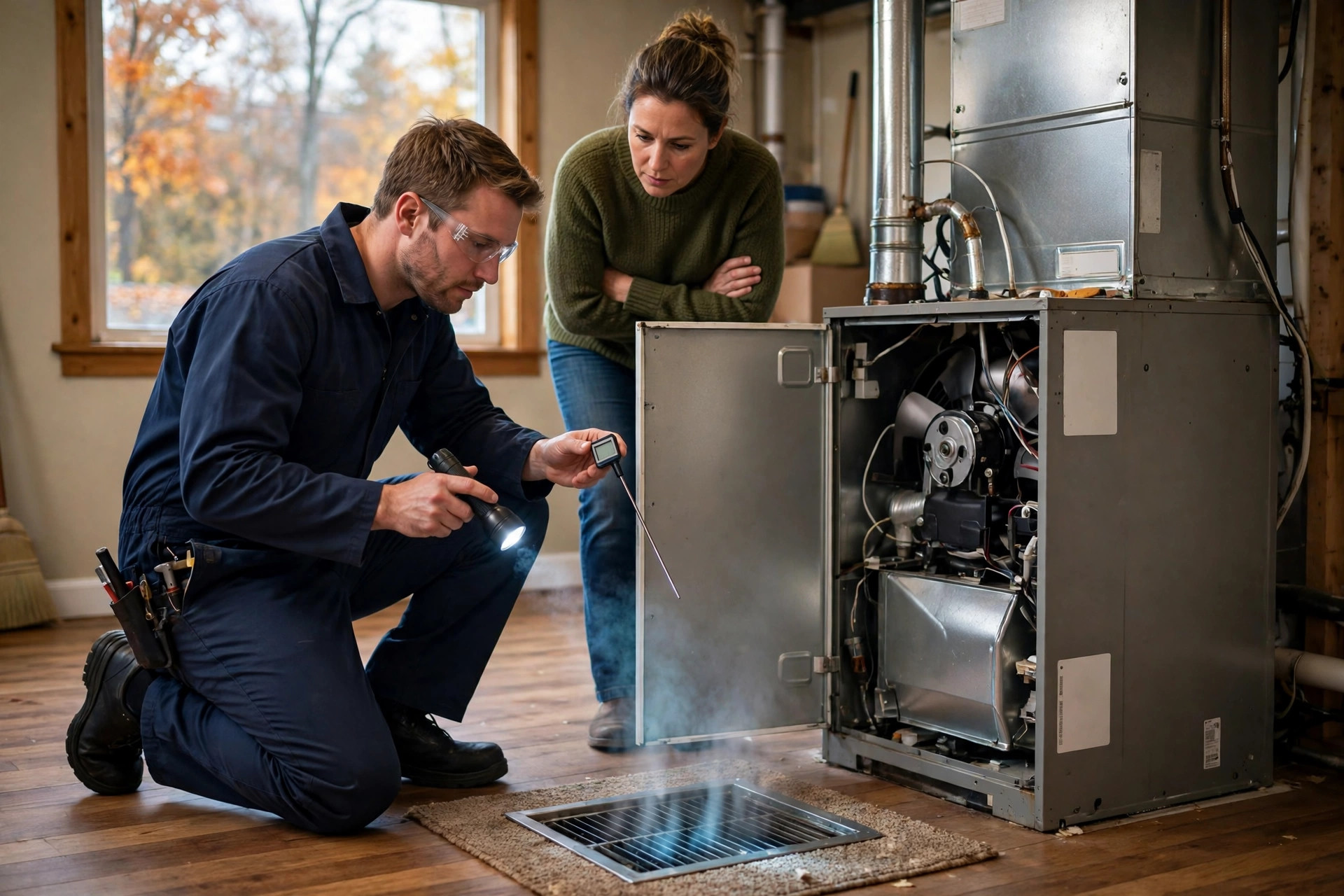
- Look through the sight glass only. Never open the cabinet. Note whether you can see a flame and whether a status light is blinking, and write down the blink pattern to describe to a technician.
- Feel several registers. If one room is cold while the rest are warm, the problem may be duct-related rather than the furnace itself.
What not to touch
Whatever is behind the furnace blowing cold air in your home, some parts of a gas furnace are never homeowner-serviceable. Leave these alone:
- Gas line and gas valve. Ontario gas work requires a TSSA-licensed technician; mistakes with gas can cause leaks, fire, or explosion. You can read how contractor licensing works on the TSSA licensing and registration page.
- Burners. They involve live gas and high temperatures, and adjusting them without training and instruments is dangerous and illegal for unlicensed workers in Ontario.
- Refrigerant lines and coils. Only certified technicians may handle refrigerant; it is regulated and requires recovery equipment.
- Wiring inside the cabinet. High voltage and control wiring inside the furnace cabinet can shock you or destroy the control board with one wrong move.
Stop and call a licensed technician if
A furnace blowing cold air is not an emergency on its own, but stop and call a licensed technician right away if you notice any of the following:
- You smell gas or your carbon monoxide alarm sounds. Leave the home and call 911 or your gas utility emergency line.
- The furnace locks out and needs repeated resets to keep running.
- An error code keeps flashing on the control board, even after you have replaced the filter.
- You smell burning, metallic, or other unusual odors coming from the vents.
- The blower runs but the burners never light.
- There is no heat at all in freezing weather. Pipes can freeze and burst, so this is urgent.
Dealing with a furnace blowing cold air today? Start with the thermostat and filter checks above. If the job needs a pro, you can post it on The Quality HVAC marketplace and let verified local pros quote it. Not sure what your system is doing? Browse the symptoms guide for more lookups.
The Quality HVAC is an information and marketplace platform. We do not install, service, or repair HVAC equipment. Content here is educational only and is not a substitute for a licensed technician. In Ontario, gas appliance work must be performed by a TSSA-licensed technician. If you smell gas or your carbon monoxide alarm sounds, leave the home and call 911 or your gas utility emergency line.



One Comment