
Furnace Squealing Noise in a Toronto Home: What It Means and What to Do First
Table of Contents
A furnace squealing noise is a high, thin sound that usually starts when the blower kicks in and fades when the furnace shuts off. It can sound like a kettle just before it boils, a slipping belt in a car, or metal rubbing on metal, and it often gets louder as the heating season goes on. A squeal is almost always a moving part asking for attention: a belt, a bearing, or a motor that is working harder than it should. This guide explains what a furnace squealing noise usually means, the safe checks you can do yourself, what never to touch, and the warning signs that mean stop and call a licensed technician.
What you are noticing
A furnace squealing noise can show up in a few different ways, and the timing tells you more than the volume. In some homes the squeal starts the moment the blower starts and stops the moment it stops, which points to the blower itself. In others the sound appears only at startup, a short screech that fades after a few seconds as the parts warm up and settle in. Sometimes the squeal comes and goes for weeks, quiet on mild days and loud on the coldest nights when the furnace runs longest, which usually means a part is wearing out rather than a part that has already failed.
Before you do anything else, note exactly when the sound happens. Write down whether the squeal starts with the blower, with the burners, or only after the furnace has been running a while, and whether the air from the vents feels weaker than usual. A technician will ask for that timing, and it points straight at the cause: a squeal at startup suggests a belt or a bearing, while a squeal that builds through a long heating cycle suggests a motor that is overheating or a blower wheel that is clogged with dust.
What it usually means
Most causes of a furnace squealing noise are ranked below, most likely first. The top two account for the large majority of cases in Toronto homes, and both involve parts that wear out with age and use.
Furnace squealing noise from a worn or loose blower belt
The most common cause in older belt-drive furnaces is the blower belt itself. The belt connects the blower motor to the blower wheel, and over years of heating seasons the rubber hardens, cracks, and glazes over. A glazed belt slips on the pulleys instead of gripping them, and the slip makes a high squeal, usually loudest at startup when the motor has to overcome the still blower wheel. The clue is timing: the squeal is sharpest in the first seconds after the blower starts and fades as the wheel gets up to speed. A belt that is visibly cracked or frayed is overdue for replacement. Belts live inside the cabinet, so inspection and replacement belong to a licensed technician.
Furnace squealing noise from dry blower motor bearings
The second most common cause is dry bearings in the blower motor. Bearings let the motor shaft spin smoothly, and the small amount of lubricant inside them dries out over years of heat and use. Dry bearings make a metal-on-metal screech that often gets worse as the motor warms up, and the sound can turn into a grind if the bearing keeps wearing. Our guide to a furnace grinding noise describes what that next stage sounds like. Bearings cannot be oiled from outside the motor on most modern furnaces, and a motor with worn bearings usually needs the motor replaced, which is licensed-technician work.
A failing blower motor
A blower motor that is wearing out can cause a furnace squealing noise for weeks before it fails outright. As the motor loses power, it strains to spin the blower wheel, and the strain can show up as a squeal, a hum, or both at once. The warning signs often arrive together: the squeal plus weaker airflow from the vents, plus longer heating cycles as the furnace struggles to move enough warm air. Our guide to a furnace humming but not starting describes that startup struggle in detail.
If the squeal comes with a hum and the blower sometimes does not start at all, the motor or its capacitor may be failing, and both parts are licensed-technician work. A blower motor also works harder when airflow is restricted, so a clogged filter can make a tired motor squeal sooner; see our guide on how to find your furnace filter size.
A dirty blower wheel and restricted airflow
Dust builds up on blower wheel blades over years, and the buildup changes how the wheel moves air. A dirty wheel can cause a furnace squealing noise as air moves unevenly across the blades, and it also makes the motor work harder, which can make a borderline motor squeal that would otherwise stay quiet. A clogged filter makes the same problem worse by starving the blower of air.
This cause is most likely if the squeal appeared gradually over a heating season, and if the airflow from the vents feels weaker than it used to. Cleaning a blower wheel means opening the cabinet and working around a spinning wheel and live wiring, so it belongs to a licensed technician, but the filter is yours to check and change.
A failing inducer motor
High-efficiency furnaces have a smaller second motor, the inducer, which pulls exhaust gases out through the vent pipe before the burners light. A worn inducer motor can cause a furnace squealing noise too, and the timing gives it away: the squeal starts a few seconds before the burners fire, while the furnace is still clearing the vent, and it stops once the burners are lit and the main blower takes over. If the squeal happens before any warm air comes out of the vents, the inducer is the more likely source. Inducer motors sit inside the cabinet and connect to the venting system, so diagnosis and replacement belong to a licensed technician.
A loose blower wheel or worn pulley
Less common, but worth knowing about: a blower wheel that has worked loose on its shaft, or a worn pulley on a belt-drive furnace, can wobble as it spins and rub against the housing. The sound is a squeal mixed with a rattle or vibration, and it often changes when you press gently on the furnace cabinet, which you should not do while it is running. Our guide to a furnace rattling noise covers loose parts in more detail. A loose wheel can damage the housing if it keeps running, so a squeal that comes with shaking or rattling deserves a technician visit soon.
Safe checks you can do yourself
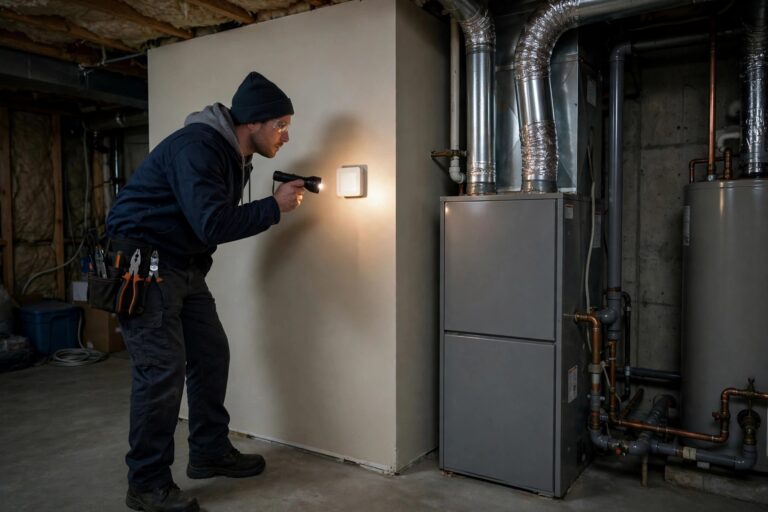
Before you investigate a furnace squealing noise, turn the furnace off at the thermostat and at the furnace switch, and let it cool if it has been running. These checks need no tools beyond a flashlight, and they never require opening the furnace cabinet.
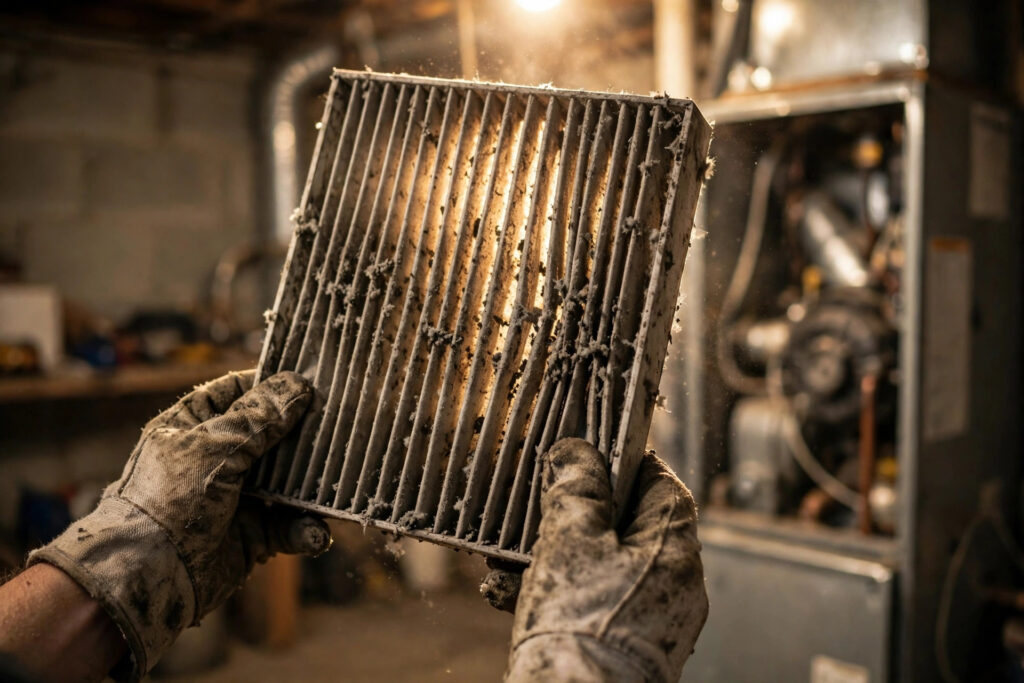
- Check and replace the filter. Pull the filter out and hold it up to the light. If you cannot see light through it, replace it with the correct size. A clean filter takes load off the blower motor and can quiet a squeal that is really a strain problem. See our guide on how to find your furnace filter size if the size is not printed on the old filter.
- Note when the furnace squealing noise happens. Write down whether it starts at startup, while the blower is running, or only before the burners light, and whether it fades or gets louder as the furnace runs. That note saves a technician time and saves you a second visit.
- Check the airflow at the vents. Hold your hand over a few supply vents while the furnace runs. Weak airflow plus a squeal points toward the blower, while strong airflow with a squeal points more toward a belt or a bearing. A furnace that runs for hours without reaching the thermostat setting is often a blower problem, and our guide to a furnace running constantly explains what long run times usually mean.
- Listen for a second sound. A squeal with a hum points toward a struggling motor or capacitor. A squeal with a grind points toward bearings that are nearly worn out. A squeal with a burning smell points toward a motor that is overheating, and our guide to a furnace burning smell explains which smells are normal at the start of the season and which are not.
- Check the thermostat and the error light. A furnace that squeals and then shuts down may also be locking out for another reason. If the thermostat is blank, see our guide to a thermostat blank or unresponsive, and if the furnace shows a blinking error light, see our guide to furnace error codes.
- Make sure vents and returns are open. Closed or blocked supply vents and return grilles force the blower to work against higher pressure, which can make a tired motor squeal. Open every vent, move furniture and rugs away from return grilles, and listen again on the next heating cycle.
- Track whether it is getting worse. A squeal that stays the same for weeks is less urgent than one that gets louder every few days. Note the date you first heard it and whether it has changed, because a worsening sound is the clearest sign that a part is on its way out.
What not to touch
Some parts of a furnace are never a homeowner job, no matter how simple the fix looks. In Ontario, gas appliance work must be performed by a TSSA-licensed technician, and opening the wrong cover can turn a small squeal into a dangerous one.
- The gas line and gas valve. Never loosen, tighten, or adjust any gas fitting, valve, or connection. If you smell gas, leave the home and call 911 or your gas utility emergency line.
- The burners. Burner parts, brackets, and orifices are set at the factory. Cleaning or adjusting them without training can cause incomplete combustion and carbon monoxide.
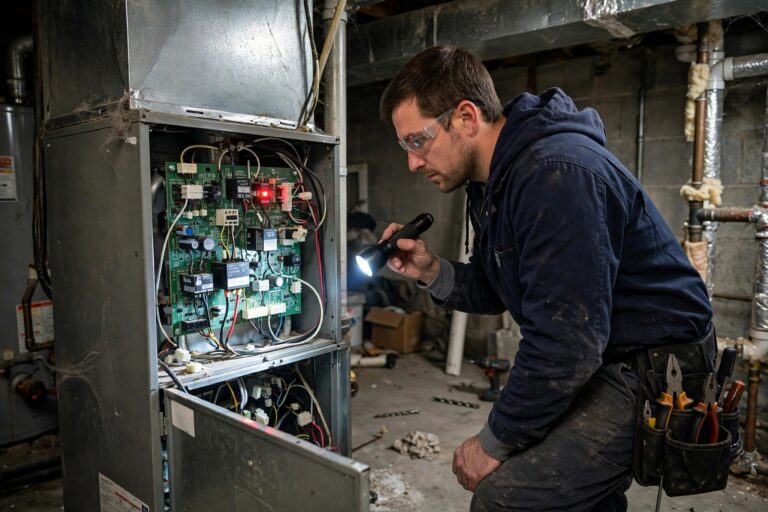
- Wiring inside the cabinet. Furnace wiring carries mains voltage and controls gas valves. Never pull, cut, or re-route wires, and never bypass a safety switch to keep a furnace running.
- The control board and capacitor. A capacitor can hold a dangerous charge even with the power off. Control boards and capacitors are licensed-technician parts.
- The blower motor, belt, and bearings. Belts, bearings, and motors live inside the cabinet, around a spinning wheel and live wiring. Replacing a belt or a motor is licensed-technician work, and oiling a sealed bearing does not fix it.
- The inducer motor and venting. The inducer connects to the vent pipe that carries exhaust gases out of the home. Never loosen or adjust venting parts yourself.
- Refrigerant lines. Furnaces paired with air conditioning share cabinet space with refrigerant lines. Refrigerant work is licensed-technician work.
If the squeal is coming from inside the cabinet, and none of the safe checks above found it, the cause is inside the cabinet too, and that is where a homeowner should stop.
Stop and call a licensed technician if
- The squeal is getting louder every few days, or it has turned into a constant screech or a grind.
- You smell burning, see smoke, or notice scorch marks near the furnace. Turn the furnace off at the switch and call a licensed technician.
- The blower stops running, the furnace locks out, or the furnace shows an error light. See our guide to furnace error codes before you call, so you can report the code.
- Airflow from the vents is weak or gone even with a clean filter and open vents.
- You smell gas at any time. Leave the home and call 911 or your gas utility emergency line. Our guide to a furnace that smells like gas explains the first steps.
- Your carbon monoxide alarm sounds. Leave the home and call 911. See what to do first when your carbon monoxide detector goes off.
- The squeal comes with shaking or rattling from the furnace cabinet, which points to a loose blower wheel or pulley.
- The furnace is more than 15 years old and the squeal is new, since worn belts, bearings, and motors become more likely with age.
- You have changed the filter, opened the vents, and the furnace squealing noise keeps coming back.
If the safe checks above did not find the source of the squeal, a technician can open the cabinet safely, check the belt and bearings, measure the motor current, and tell you whether the fix is a belt, a motor, or a cleaning. For gas work, you can confirm a technician’s registration through TSSA’s fuels contractor lookup. For a broader look at what each furnace symptom means, browse the full list on our symptoms page, try one of the free calculators on our tools page, or look for parts and equipment on our marketplace.
Most of the time, a squeal like this turns out to be a worn belt or dry bearings, and catching it early is the difference between a belt and a motor. The check that matters is the one before the call: note when the squeal happens, check the filter, and listen for a second sound. A squeal that fades after a filter change is a maintenance win. A squeal that gets louder every few days, or one that comes with burning, grinding, or weak airflow, is a repair job, and it should not wait for the weekend.
If the job needs a pro, hire a TSSA-licensed technician and ask to see their licence before any gas work starts.
The Quality HVAC is an information and marketplace platform. We do not install, service, or repair HVAC equipment. Content here is educational only and is not a substitute for a licensed technician. In Ontario, gas appliance work must be performed by a TSSA-licensed technician. If you smell gas or your carbon monoxide alarm sounds, leave the home and call 911 or your gas utility emergency line.